
Chapter 16
Documenting the Dance
Philippa Cullen
Over the late 1960s-early 1970s the young dancer and choeographer Philippa Cullen [1] trained at the Bodenwieser Dance Studio (City Rd, Sydney) with Keith Bain [2], Margaret Chapple and Jacqui Carroll. She was also a student at the University of Sydney, graduating in Fine Arts, Italian and Medieval History in 1970, and had become deeply interested in the communal function of dance as represented in the medieval Mummers (travelling actors presenting their plays in the towns of medieval Europe) and in African and other traditional societies.
When the video portapak became available in Australia around 1970 among its early use in the arts the documentation of Philippa's works (c. 1969-72) is of considerable importance, although she didn't actually use video herself. The actual video-makers would have included students in the Fine Arts Workshop at the University and others such as Doug Richardson, who had become involved with several artists (among them Bush Video) through his early work developing a computer graphic system.
During that period Cullen ran improvisation workshops at the University and established a friendship with Greg Schiemer, a composer who was becoming active in experimental music in Sydney at the time. She had also worked with winsome Evans of The Renaissance Players during her studies with Frederick May.
Philippa was also interested in the use of new technologies in performance - particularly those, such as the theremin, that allowed her to make sound directly from the dancer's movements - and was working “towards a new medium in which dance is inseparable [from] technology, music and lighting”.[1] As Jacqui Carroll later said of her work: Cullen was mainly interested in the process of dance, the process of experiment.[2]
In mid-1969 Donald Brook (then a lecturer in the Fine Arts Department) introduced Philippa to an interactive environment based on a theremin [3] built by a small collective of electrical engineers interested in the arts called Optronic Kinetics (David Smith, Jim McDonnell and Kaz Kondziolka) at the University's Fine Arts Workshop (aka the Tin Sheds). The unnamed responsive installation was set in a room with a grid of black and white tiles spread over the walls which were lit with UV light. As far as can be determined the Optronic Kinetics installation used a wire strung along the wall of one of the Fine Arts Workshop studio spaces. According to David Smith:
“It consisted of a dark room in which was placed a cathode-ray screen controlled by a radio frequency device sensitive to movement. As one moved about the room a wave pattern changed form on the screen and a sound of varying pitch was emitted from the device called a theremin.[4] The room was bathed in ultraviolet light which caused a matrix of phosphorescent squares to glow in the darkness.“[5]

Fig.1: Block diagram of the Theremin.
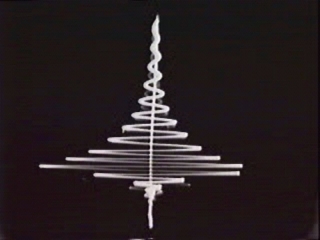
McDonnell attached the beat frequency audio signal output from the theremin [Fig.1] to an amplifier so that it produced its usual distorted sine-wave squealing as one walked nearer to it. Smith described it as being quite raucous.[6] Kondziolka then added a circuit to amplify this signal from the theremin to drive the deflection coils of (again, according to Smith):
“an old colour television set ... modulat[ing] the field producing a rotating Lissajous figure used in engineering to detect phase change”. [7]
However, since this was well before the days of colour TV in Australia, in a conversation with Kondziolka he told me that it was actually a black and white TV with a colour wheel of the three primary colours set up in front of it, spinning at a rate synchronised with the theremin frequency to produce coloured Lissajous patterns, changing and swirling as the viewer moved around in the antenna fields of the theremin. However, the colour wheel, being quite large became very easily unbalanced and ended by smashing.[8]
This would have been Philippa's first experience of the use of the video screen other than as a television.
Cullen was evidently quite inspired by the installation and mentions it in a notebook from the period:[8]
“David Smith, electrical engineer, constructed an “objet d'art” for the Fine Arts workshop which reacts by light & noise to any interference. He wants to compose music for ballet.” [9]
She then engaged David Smith to help her develop a system that dancers could use. She says, in a 1973 grant acquittal report:[10]
“I suggested that we find a way in which the whole body could be used to create the sound. The engineers were not at all sure that a large aerial would work or how big the range would be, but after much encouragement from me we found that a triangle of copper wire produced an electro-magnetic field that covered the whole stage. So my first major ballet, Electronic Aspects, was built around this triangle antenna with the sound merely an oscillating sine tone where each movement caused a change in the pitch.“ [11]
The ballet she made for the theremin was called Electronic Aspects. There is no known video documentation of it, however Philippa's notebook has several pages of movement guidelines for each of the dancers in the ballet. [12] Fig.2.

Fig.2: Cullen's choreographic note for Jacqui Carroll's movements in Electronic Aspects.
Note the triangular drawings indicating the placement of the theremin antennae
around which the dancers would move.
Soon after this she began working on another ballet called Utter (1971-72) and a second which became Homage to Theremin II (1972). There is video documentation of both of these.
Utter was choreographed for the 1971 Ballet Australia Choreographic Competition. Based on phonemes from the four languages that George Alexander, her partner at the time, spoke. Utter “explored the use of the voice as a sound source for dance and received a special mention in the competition [Carroll, 1975]. Cullen presented Utter again in April, 1972 for AZ Music's Sound Ventures III. As one reviewer described, the sound came directly from the four dancers who
“hissed, chanted, droned, whispered and shrieked their own stream-of-consciousness accompaniment as they pranced around in a cleared space in the centre of the auditorium. It was full of vitality, sometimes as beautiful as a temple frieze, sometimes deliberately ugly, occasionally just for fun.” [13]
Phillipa wrote, in the program notes for the AZ Music Sound Ventures series in which Utter was performed
“Cage has denied the existence of music itself, if music is considered as hearing isolated from sight, touch, smell, etc.
I deny the importance of dance itself, if dance is considered as movement isolated from voice, touch, sight.
This ballet [Utter] explores the relationship between movement and sound when both are made by the performers who are no longer merely dancers; they have to be musicians and actors as well, just like the commedia dell'arte.
Mostly they interpret instructions given by me beforehand rather than perfect certain steps.
The structure is alogical and depends upon sensory relationships between the performers and the audience.” [14]
An Akai 1/4-inch video portapak had become available and was used to record Utter and rehearsals of the later Homage to Theremin II (1972).


Figs.3 & 4: Still frames from the video of Utter
The video of Utter begins with credits for the dancers and the sound followed by descriptions of what the dance consists in. Then we open to a stage with a circle of light projected on to it as five young women dancers stream out from backstage and run (while emitting a continuous cry, said to be the word orgasm ) around the circle to assemble in its centre. They then start a series of angular gestures making various short utterances timed to each gesture. With each gesture they begin to step away from each other, as the disk of light expands. This continues for a minute or so and they end up standing at the four corners of a square with the fifth dancer at the centre. The two dancers in the back corners of the square advance forward to stand behind the two at the front who then bend forward, hands reaching the floor, as the dancer behind each of them begins a drumming action on their lower backs. The dancers, in their forward bend, then stomp away from their corner positions and meet at centre-front where they and the other dancers begin a faster rumbling of their feet on the stage.
The other dancers then begin a series of gestures in which they raise and lower their arms followed by movements raising one leg, as two dancers in the centre go through tilting and rotating motions. During the whole sequence each gesture/motion from each dancer is accompanied by a loudly voiced phoneme. The dancers work back into a cross formation with the centre dancer moving forward to stand behind the one at the front point of the cross. The lights then fade out. Clapping and foot stomping sounds are heard as the light slowly fades up revealing the dancers holding hands, pulling themselves into a circle as the sound becomes increasingly intense at which point they all fall to their knees, crawl around while making swishing sounds that become more articulated, emulating real speech. The crawling becomes more upright and they form two pairs with the stray dancer moving from pair to pair. The sound is now far more articulate though still not understandable. The two pairs and the stray become a pair and a triple and they stand in spotlit areas of the stage. They now move as though they were in a highly gestured conversation and the sound emulates the rhythm of conversation, which almost becomes understandable given the gestural accompaniment. The two groups enter something of a boxing match with gestures and stomping that might have come from the actions seen in a fight. This ends up focussing on one dancer who jumps up and breaks the group (now in pairs) which returns to the triple and pair they began as, the triple engaging in laughter and gesture while the pair engage in a tugging of hands and arms swing wildly around as they tug. Ultimately four of the dancers whirl off stage leaving a single one, arms crossed, standing at the focal point. She remains standing there as, in a chorus of voices, the other four stream back onto the stage. They all then engage in individual dance/movement/gestural play, laughing, one crawling, others tumbling as the stage lighting fades and the spotlight returns with the dancers now stalking around it, gestures becoming more tired and drooping, each dancer making popping sounds as they collapse into a pile in the spotlight, from which they rise, forming a backward turning circle and unwinding off the stage. Applause. [The dancers were Margaret Knightly, Christine Koltai, Gail Flanagan, Deirdre Evans and Delwyn Rouse.]

Fig.5: Cullen and dancers rehearsing with the theremin antennae for Homage to Theremin II.
The video of Homage to Theremin II (1972) is a rehearsal recording, it does not show the finished coherent dance performance. The four dancers, Philippa Cullen, Jacqui Carroll, Maggie Knightly and Peter Dickson with the sound engineer, Phil Connor, and composer, Greg Schiemer, are working out how to use the four theremin antennae, which were designed by the architect Manuel Noblaza. The video is as much an exploration of possible movements that could trigger the theremins although we are not at all certain where the sound is being triggered from. Two dancers stand on two disc shaped pedestals and as they move, mostly waving arms up and down, the theremin pitch changes in accordance. Jacqui steps down to the floor, walks across to the other pedestal and pulls Beth off it, replacing her. The other dancer walks over and stands under what was called the “bonnet” antenna which consists in a net of wire mesh. The theremin sound rises and lowers in pitch as she moves her hand towards and away from it. Jacqui is then seen on her knees on one of the pedestals, bending down over it and then raising herself. She stands and makes new movements some of which produce sounds... the engineer and composer are still sorting out which antenna should make what sounds. For a moment Philippa is seen laying on the floor under a long thin standing metal tube antenna. Following this Jacqui and Philippa engage in a duet, both standing on the one pedestal, arms and legs entwining each other in exquisitely disciplined movement. It is almost a slow struggle to capture the pedestal. They stop and Jacqui moves off to claim the other pedestal. Her movements then appear to reach up to pluck sounds from the air (to use a reviewer's phrase in describing the actual performance) while Philippa coaxes sounds from the long thin wire. The male dancer is then seen under the bonnet. There is also a beam pointing at a photoelectric cell. A dancer could break the beam, stopping and releasing the sound as they moved through it. Finally the dancers engage with and produce more acoustic sounds, hands clapping, a series of pops and then settle back into the work of discovering how their movements can effect the sound.
Cullen then went overseas, returning in 1974 to continue with her experiments in dance and interactive technology.


Endnotes
1 See Stephen Jones, Synthetics: Aspects of Art and Technology in Australia, 1956-1975, (2011), Cambridge, Mass, USA, MIT Press.
See also the catalogue for Philippa Cuillen: an Archive, an archival exhibition curated by Stephen Jones at SNO (Sydney Non-Objective) gallery, Marrrickvile. (23 April-22 May, 2016). For a review see: Realtime : Tribute to a pioneering dance-media artist.
2 Campbell, Michael, (2010), Keith Bain on Movement, Sydney, Currency House.
3 Greg Schiemer, interview, 19/5/05.
4 The timing of the appearance of the many theremins used by some of the electronic artists of the period suggests strongly that they were based on a theremin circuit by Leo Simpson, which was published in Electronics Australia, June, 1969.
5 Philippa Cullen, (1971), “Application to the Australian Council for the Arts for assistance in 1971/72&rdquo';. Now in the Cullen archive in the National Library of Australia, Canberra.
6 Ibid.
7 Jilba Wallace, (1976) Philippa Cullen: A Life's Work, videotape.
8 The timing of the appearance of the many theremins used by some of the electronic artists of the period suggests strongly that they were based on a theremin circuit by Leo Simpson, which was published in Electronics Australia, June, 1969.
9 Kaz Kondziolka, conversation with Stephen Jones, 8/2/2003.
10 David Smith, 1995.
11 Ibid.
12 Philippa Cullen, Grant acquittal report for the Australian Council for the Arts, dated 31 May 1973.
13 Probably written late July or early August 1969. The note appears a page after another note which was dated 25 July 1969.
14 Philippa Cullen, Grant acquittal report for the Australian Council for the Arts, dated 31 May 1973.
15 In her report to the Australian Council for the Arts, dated 31 May 1973, in the section headed “Electronic Projects, 1970” Philippa describes the theremin as using a metal plate antenna. This was written in 1973 and is at odds with the descriptions given to me by David Smith and George Alexander. As far as can be determined the Optronic Kinetics installation used a wire strung along the wall of one of the Fine Arts Workshop studios and Cullen on seeing this installation then engaged David Smith to help her develop a system that dancers could use.
16 Philippa Cullen notebook, now at the National Library of Australia.
17 Philippa Cullen, notes on Utter for the AZ Music Sound Venture series, April 1972. Copy of the handwritten Programme Notes in the Cullen archive at the NLA, Canberra.
18 Maria Prerauer, Probing into new dimensions review of AZ Music's Sound Ventures series performance by the group Teletopa, which included a performance of Utter, in “Arts and Entertainment”, The Australian, 23rd April, 1972, p.22, (1972)
19 Philippa Cullen, notes on Utter for the AZ Music “Sound Venture” series, April 1972. Copy of the handwritten Programme Notes in the Cullen archive at the NLA, Canberra.