Chapter 6
Video is not Film
So this was a generation on the brink of change. Among those changes was the way we thought about the media, particularly television. Those of us interested in new electronic media, especially video and the potential it offered for television, read Radical Software [1], the journal of the experimental video scene in the US (which ran from 1970 to 1974, but probably wasn’t seen here until late 1972).
Video is the unruly child of television. It has its origins, like its parent, in the telegraph and the facsimile, not photography and film as is generally supposed. However television and video have long been conflated with film since both are moving-image media. Perhaps this has its origins in the “midday movie” in which the presentation of narrative films became the mainstay of television.
But, this conflation became the primary way in which video is understood. For example, Lev Manovich, in his Language of New Media [2] asserts that the cinema and television/video are both representational technologies in that they create an illusion of (i.e., they represent) the real, although he fails to recognise the entirely different means by which each do that. The one differentiation between cinema and video that Manovich does allow is that the content of the video screen (and the radar screen) can be modified or continually updated in real-time, [3] unlike the cinematic image which has to be set up, shot, processed, edited and printed into a sequence of unchangeable frames which are then projected onto a passive screen.
To cinema and television he adds computer-generated imaging (computer animation), given that they are each used to create the illusion of some sort of reality in the depths of the screen projection, while maintaining that cinema is the precursor and primary source of this illusionistic practice. [4] This screen projection is what I would call a navigable space in that one navigates it with one’s eyes and memory by looking at different objects in the screen space (as one does the outside world) and making of them what one’s acculturation has established. But this is not how Manovich uses the term. [5] For Manovich a navigable space requires access to a database of possible (data)spaces available, for example, in a computer game through which one is transported with the aid of an interface. [6] It is the conversion of the content of various prior media types into the digital and the new types of space that that conversion enables, such as computer games and the Internet, that for Manovich is the crucial step to new media and since computer-based imaging is digital he regards it as being the overarching new medium. As Manovich puts it:
“All new media objects, whether they are created from scratch on computers or converted from analog media sources, are composed of digital code; they are numerical representations.” [7]
Thus his differentiation of new media is based on a digital, versus analogue, means of information carriage. It is, for much digital moving image work, the way in which the potential interaction is implemented.
Manovich's intent appears to have been to provide a technological history and contemporary analysis of computer imaging (in its widest possible instantiation) and to do this he has ignored aspects of analogue imaging or representation. However by ignoring the technical aspects of (analogue) television and video we also lose a variety of other ways to inquire into its aesthetics.
Manovich treats all the visual media as representational, be they cinema, television and video, or the computer image, in that they each project onto a screen, [8] which he imagines to be a kind of window frame, despite the massive technical differences between the types of screen that are the site of that projection. Through this window the viewer looks at some re-constructed reality, whether that is a representation of the place in which the film is shot, or where the news is gathered, or the TV studio, or some other real or constructed or even synthetic (i.e., generated) location/set wherein the action takes place. But the real screen is the retina in the rear of the eyeball, or perhaps even the mind's eye upon which we project our interpretation of what that screen (the retina) receives [and ultimately we have to acknowledge the quantum problem of whether what is actually out there is what we see, given that what we believe to be there is a construction learned through our induction into the world].
As with the retina the film or photographic image is acquired in parallel. The molecules of photosensitive material on the film (the celluloid), the photographic plate or in the retina are spread out (more or less) flatly across the photosensitive region with the image focussed onto it by a lens. In other words, the whole image is available at once (in a single opening of the shutter). But in analogue video or television while the image is stored in parallel on the photo-sensitive surface of the imaging tube or chip, it is then read from that surface sequentially (i.e., it is scanned), with synchronising signals driving the reading beam across that light sensitive surface continually reconstructing it through time, on a point-by-point basis. This is the real difference between film and video. [This is also how a computer-based scanner works in picking up images from a photographic print or similar for use in the computer, although in this case each whole line is gathered in parallel but read sequentially while the whole 2-dimensional image is scanned one line at a time.]
Another factor that we need to account for is that in the cinema the scale of both the screen and the image projected onto it promotes an identification between the viewer and the scene being projected whereas in television and video the viewer is not contained within the immersive space of the cinema and its screen and, mostly, is not led to identify with the content but is removed from it, standing in a more objective position, regardless of any objective/subjective dimension in the content. The viewer thus is in a position that allows a critical stance, a potential for disbelief.
So what Manovich has done is to separate out the digitally-encoded visual from the analogue visual, i.e., he has isolated out computer-mediated digital information from continuously variable analogue information by giving the digital forms the exclusive right to the label new media. However, video and film have now become almost exclusively digitally mediated as well so this division is no longer of any use. What really counts in making the attribution new media is whether it is chemically or electronically sourced, and the ultimate point about video art is that it is an electronic art and bears the same relation to film as electronic music bears to orchestral music. The actual medium used in (re)presenting the image is not the point, it is the means by which it is originated that counts. But, today, whether that medium is analogue or digital electronics is of little interest to the viewer given that the actual information carrier (the video) is most likely to be of digital form, and so I argue that the new media are the electronic media of which computing is but one type.
Having argued that it is electronic versus chemical mediation that counts, I will take a look at the technical aspects of this electronic medium that is video. Video is a form of writing derived from the scanning techniques developed by one Alexander Bain in the mid 19th century so as to transmit over the telegraph wire the signature of the person sending, in particular from one bank to another, the funds by which commerce could proceed. [9] [Fig.1]

Fig. 1: Diagram of a 19th century facsimie machine..
Bain and other early experimenters working with the telegraph [10] discovered that, by scanning a two dimensional image in a line-by-line sequence it could be rendered in one dimension and transmitted down a wire. However, to re-assemble the image at the receiving end it had to be possible to know when each line finished so that the next line could be placed below it on the page. If this process of synchronisation is done automatically by sending a pulse down the wire at the start of every line then it can be automatically re-assembled. In this the facsimile and video are not that far from typing and computer printing in which the carriage return sets the printing head back to one edge of the page ready for the next line. If another, more significant pulse is sent at the start of every page then a sequence of pages, or frames as they became known since they were set by the boundaries of the picture, can be transmitted and reconstructed at the receiver. Of course the end result may well be the illusionistic image of the cinema, but its technical process offers the possibility of entirely other non-iconic (i.e., synthetic) means for making images.
It is these other means (e.g., video sculpture and video synthesis) that appear in early (i.e., 1960s and '70s) approaches to video art (independently of the opposing tendency towards documentary as an activist form) that make early video art both interesting and in its more experimental forms unrecognised (until 1973 ?? Tim Burns) within the framework of critically accepted contemporary art in Australia, although this was not so much the case in the US. [11]
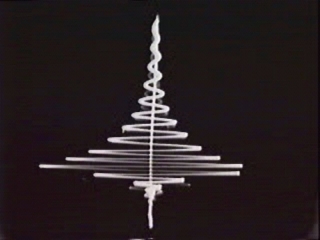
Until the digital age, the scanned and reconstructed image formed as changes in brightness (i.e., changes in the voltage) of the signal rendered onto a raster, or grid was the standard form of tele-visual display in which the intensity of a pencil of electrons (the beam) is modulated to form a tonal image. The electron beam, when scanned across the rear (the inside) of the phosphor surface of the screen of the cathode-ray tube, inscribes the image onto it. The inscribed line then glows with light from the phosphor projecting the image onto the retina of the viewer. However the screen does not necessarily have to be scanned as a raster. In the early development of the cathode-ray oscilloscope the electron beam was moved around the phosphor screen of the tube quite freely by continuously varying the magnetic fields that focussed those electrons. The kind of image that could thus be produced is very close to writing and was described as calligraphic. Lissajous figures displayed on an oscilloscope are an early use of this approach. A more rigorously controlled (but still calligraphic) motion of the beam later became used in early forms of computer graphics, with the wire-frame image being what was most easily produced. The calligraphic display [12] was more commonly used for computer output because it did not require extensive computer memory to store the image while it was being read out to the screen, thus making it very much cheaper given the high cost of early forms of memory. [13] But it was also an important approach taken in early video art in the search for electronic means for directly generating abstract images (video synthesis) both in the work of some American video artists. [14] and in particular for this discussion, artists working in Australia (e.g., Stan Ostoja-Kotkowski or John Hansen) who explored the television set, and later video as well as electronic music.
The inscription of the electron beam onto the screen of the display makes video a one-dimensional stream of information and, given that the raster of standard television and tonal bit-mapped computer graphics, is a special form of Lissajous figure, all (analogue) video is actually more a form of writing. [15] than it is photography. We can see this especially in Ostoja-Kotkowski's electronic drawing, Hansen's video synthesis and Bush Video's video feedback work, both in Australia. [16]
So the upshot of all this is that as non-broadcast television, video possesses characteristics which, when recognised, show it to be a very different medium from the colonised form that television has taken in recent years.
Video as memory
One aspect of video that renders it significantly different from film and television is its immediacy: you don t have to wait for it to be processed before you can see the image. Because the video signal is electronic, it can generate live or real-time images that do not have to be recorded. This liveness can offer a, what I will call here, turn-around time of microseconds. That is, video has a capacity to provide instant feedback [Fig.2] of its content for further intervention. Feedback, in its several forms, can take from microseconds to as long as one wants to hold onto the signal (supposing one records it by writing it to tape or disc, or now-days, computer memory) [Fig.3].

Fig. 2: Diagram of a basic video feedback loop.

Fig. 3: More complex video feedback loop mixed with a pre-recorded video signal..
It is the short turn-around time of the video signal that is the significant factor in its use as a reflection on both itself and its content in video synthesis, and it is the longer turn-around time that characterises its use in socio-political feedback situations, for example as used in performance training and in social analysis and activism.
Thus feedback is a form of memory, a holding on to current information for analysis or for comparison with future information. Just as in psychology memory is divided into short-term and long-term memory, so we can see a division in the ways that video is used based on the duration of the feedback cycle. Short-term feedback cycles produce a kind of image that is commonly used in what I call synthetic video, while long-term feedback cycles produce the kind of memory that we normally think of as being something that we use to communicate with others about things that are of common concern or interest. In the period under discussion here, this came under the general rubric of documentation, whether it was of a performance art work or of a politically potent activity within some community; the only differences in these latter being the intentions of the author(s) and how much editing might be thought necessary. Fast turn-around feedback cycles tend towards the formalist or abstract in aesthetic terms, whereas the long-term feedback cycle correlates with the use of video as a recorder of images that are figurative rather than abstract.
The implication of these turn-around cycles and their durations is that video is first and foremost a process-based art, and it is this aspect of video as process that was a hallmark of much early video art produced in the US and appears to some extent in the more synthetic and meditative works of Bush Video and several other early Australian video artists. But Bush Video's synthetic works are also perhaps among the best examples of video as a kind of writing.
Where the feedback cycle is irrelevant to the work, then it returns to the filmic (illusionistic) role to which much contemporary video art has fallen, simply being a presentation of some pre-structured narrative, essentially cinema but produced on video simply because of its accessibility.
Ultimately, especially during this period when video art was in its infancy, it was the cost factor that was its most problematic and most limiting characteristic. Much of the early video art existed in a culture of limited means. The fact that one could make moving pictures (albeit monochrome) and show them to others without having to raise the thousands of dollars necessary to make a film or a television program was, often enough, all that was needed, especially for activist purposes. If you really wanted colour video it was possible to get sponsorship.
The first provision for the funding of experimental film was made through the announcement in August 1969, by the then Prime Minister John Gorton, of the Experimental Film [and Television] Fund (EFTF) [17] and its first call for applications in April 1970. At that time it was administered by the Australian Film Institute (AFI) with funding from the Film and Television Board [later the Film, Radio and Television Board] of the Australian Council for the Arts. [18]
There then began a complex (and difficult to untangle) series of re-structurings in which a number of bodies charged with supporting the growth of the film and television industry in Australia came and went. One early body was the Australian Film and Television School which was broached in 1969, shelved for several years and then actually established in 1973. [19] The third (February 1972) report of its planning body, the Interim Council for the National Film and Television Training School, notes that it had taken over the programmes initiated by the Australian Council for the Arts.
In January 1973 the then Prime Minister, Gough Whitlam, announced that the Australian Council for the Arts would be re-structured as a statutory authority to be known as the Australia Council. The Film and Television Board was established within the Australia Council and took over the administration of three funds: the Experimental Film and Television Fund (EFTF), the Film and Television Development Fund and a General Production Fund. [20] However the EFTF remained under the administrative control of the Australian Film Institute.
In February 1974 the Film and Television Board announced that it was about to help launch a series of public access TV centres. A press report by Ian Moffitt in The Australian of 18th February 1974 under the banner Channel Everyman, notes that + The public access concept or compromise copies of it are sparking excitement in the media. A visiting BBC expert lectured on the subject last week. + Bush Video, Sydney's alternative TV group, claims it is making the possible TV of the future when cable TV subscribers select programs from a central computer bank of tapes. It is trail blazing in audio-visual processes. + The Australian Post Office and the Department of the Media examined the future Australian cable system at their national telecommunications plan seminar last week in Sydney. Sound and vision will connect to homes like gas, electricity and phones.
+ The initial blueprint is for storefont videotape centres which will encourage people to use, not merely receive, television.
+ No cable networks will screen their images around the nation. They will screen their own efforts in the centres, or before council meetings, government enquiries, community groups or commercial channels which might air them for outsiders.
+ The plan is to establish community access video centres, including a national video resource centre in Sydney which will incorporate a library, cinema, restaurant, editing rooms and community baby health centre. A small staff will guide the amateurs and edit their work.
+ Melbourne will have a centre in Carlton (in collaboration with the Australian Union of Students) and further satellite-type centres will spring up in Sydney, Melbourne, Whyalla, Fremantle and Brisbane.
+ Sydney's proposed centres, in co-operation with the Department of Urban and Regional Development, will be in the fast growing Parramatta, Blacktown and Liverpool-Fairfield districts. Victoria's will be Altona and Footscray. Groups of individuals will use portable video recorders under the guidance of a centre director.
+ It's an exciting prospect. The Australian Film Institute will set up the centres in a 12-month pilot scheme and groups are already clamoring to use them as sociological tools to strengthen their communities.” [21]
In 1975 the Labor (Whitlam) Government re-organised everything again: creating the Australian Film Commission (AFC), which was to handle all aspects of government funding for film and television, apart from the Australia Film and Television School. [22] Then, after the dismissal of the Whitlam government in November 1975, the incoming Fraser government decided that all funding for film (and, by default, video) production, distribution and exhibition would be handled by the AFC. Thus in late 1976 the functions of the Film, Radio and Television Board were transferred from the Australia Council to the AFC including the EFTF, the Australian Film Institute (AFI) and the Video Access Centres. [23]
The video access centres were transferred to the AFC and pretty much told to look after their own funding. The EFTF was transferred to the newly set up Creative Development Branch of the AFC along with the Film Production Fund and the Script Development Fund. [24] But, as Megan McMurchy has noted, this brought a shift in emphasis from creative film-making to the needs of 'industry' despite the act of Parliament that set up the AFC requiring it to give 'special attention to the encouragement of the making of experimental programs and programs of a high degree of creativity'.[25]
However, ultimately it was the Film and Television Board of the Australia Council, over the period from 1973-1976 that made the big difference in the possibilities, especially with its establishment of the Video Access Centres in each of the major cities and some of the more culturally impoverished regions where the need for a community voice was seen to be of value. I will discuss the establishment of the Video Access Centres in more detail below, however it is in Video Access that the social feedback potential of video was seen to be of considerable importance.
2 Manovich, Lev (2001) The Language of New Media, Leonardo Books series, Cambridge, Mass.: MIT Press.
3 Manovich, op cit, (2001), p.99.
4 Compare Manovich, 2001, p51. Manovich notes that all new media are re-presentations of discretised, i.e., sampled, events, whether those samples are temporally or spatially distributed. In fact even the spatially distributed samples are discretised over time, whether the clocking through addresses of each pixel as it is presented or the stepping through the lines of a video frame or the stepping through frames in film.
5 Manovich, op cit, (2001), p.244ff.
6 Manovich, op cit, (2001), p.250-1.
7 Manovich, op cit, (2001), p.49.
8 Manovich, op cit, (2001), p.16.
9 See Standage, Tom (1998), The Victorian Internet: the remarkable story of the telegraph and the nineteenth century’s online pioneers. London: Weidenfeld & Nicolson, 1998.; The book is reviewed at Standage's web site The Victorian Internet ,
10 Beginning with Alexander Bain in 1843, but working through all the pioneers of the electric telescope; Paul Nipkow, through to
John Logie Baird and Vladimir Zworykin, and on to modern broadcast television.
11 In the US numerous articles and books covering all forms of video art were published, including the journal Radical Software, and Michael Shamberg’s Guerrilla Television [Shamberg, Michael and Raindance Corporation (1971) Guerrilla Television, New York: Holt, Rinehart and Winston.] Paik’s eccentric persona would have contributed to this but the cultures of New York and Los Angeles were always open to the technologically new and innovative. Not that we weren’t here but the art world seems to have been rather more reluctant to embrace technological forms.
12 Also known as the vector display. The notion behind the calligraphic display is that it is written or drawn by a pencil, or beam, of electrons. This usage, the pencil, goes back at least as far as Newton’s experiments on the constitution of light wherein he allowed a pencil of light to travel through a prism so that it was split revealing the spectrum of colours from which it was made.
13 It was only in the later 1970s, with the development of cheaper memory, that the raster scan was used.
14 In particular, users of video synthesisers like the Paik-Abe video synthesiser, the Rutt-Etra and the Scanimate.
15 And it’s probably not unreasonable to suggest that writing is in fact a specialised form of drawing, given the role of hieroglyphics and the ideograph in the history of writing.
16 And as Albie Thoms of Ubu Films, which we shall meet later, notes: there were a number of times in Yellow TV (which we shall also discuss below) when the camera operator pointed the camera at a light and proceeded to write with the light. In one instance this resulted in a burn on the picture tube, which would have needed 12 hrs pointed at a white wall to eradicate, so it was left to mar subsequent video pictures, an unfortunate decision, but one in keeping with the anything goes attitude of the times. [Thoms, conversation, 3/5/05]
17 See the Press release: Canberra, Sydney, 3 December 1969: Recommendations of the Australian Council for the Arts for 1969/1970, Statement by the Prime Minister, Mr. John Gorton, [in particular p.3]. NAA: A5915, 743
18 Annette Blonski, Barbara Creed, Freda Freiberg, eds., Don't Shoot Darling!: Women's Independent Filmmaking in Australia, (1987) Greenhouse Publications, Richmond, VIC, Australia. p.45.
19 Alex Gerbaz, The legacy of the Experimental Film and Television Fund, 1970-78 a paper given by Dr. Alex Gerbaz to the National Archives of Australia, Canberra, 13 October 2009.
20 Annette Blonski, Barbara Creed, Freda Freiberg, op cit, p.46.
21 Official Year Book of Australia, Issue 60, 1974, Australian Bureau of Statistics, Canberra. p.1022.
22 Ian Moffitt, Channel Everyman, The Australian, 18 Feb, 1974, p.12.
23 Annette Blonski, Barbara Creed, Freda Freiberg, op cit, p.46.
24 Alex Gerbaz, op cit.
25 Megan McMurchy, “The Creative Development Fund 1978-88: Breeding Ground for an Industry, or Seed-Bed of Invention?”, in Megan McMurchy and Jennifer Scott (eds), Signs of Independents, Ten Years of the Creative Development Fund, Australian Film Commission, Sydney, December, 1988. p.3.
Endnotes
See also the Google Books version, which has most of the pages of Sabine's (1867) book The Electric Telegraph
and
Jones, Stephen (2005),
The Electric Telegraph, Sydney: Stephen Jones (privately published).
See also Jones, (2005), op cit, Electronic Imaging Begins,.