Chapter 7
The Sixties in Australia
Strange ideas had begun to develop in the 1960s, particularly amongst the younger generation. Perhaps it was Elvis Presley's fault, perhaps it was Jack Kerouac, perhaps it was the Beatles or for me it was Bob Dylan. But the point is that suddenly we: Australians, and particularly younger Australians, discovered that we could think for ourselves despite having been told throughout the 1950s that we should rely on our British forebears, the patrician culture and politics of Menzies and his defenders, and the military support of the US. These led to our political angst, a result of growing up in the aftermath of World War II when so many terrible things had happened, and we were encouraged by some to try and find new ways that perhaps would not lead to another: a third world war and, in this new case, the inevitable destruction that that would bring through nuclear weapons. WW3 got so close with the Bay of Pigs (1961), the US invasion of Cuba [1] and the Cuban Missile Crisis (1962), in which Soviet Russia supplied nuclear weapons to Cuba [2], and then the Beatles released Love Love Me Do (1962). Suddenly there was a brightness, but there was also a lingering knowledge of the darkness. Bob Dylan brought us the notion that there was something Blowing in the Wind (1963) which, along with Simon and Garfunkel's Sounds of Silence (1964), highlighted the terrible things that society was doing to its people. Then in 1965 Barry McGuire released The Eve of Destruction which raged against the horrific consequences of any war for the young people forced to fight it as well as the absolute fear of nuclear war. [Apologies for all the advertising you get on Youtube, but I thought you might like to listen to the songs. SJ]
 Fig.1: 3 frames from some Portapak vIdeo shot near Central c.1973.
And there was something in the wind, despite that charge of hope and excitement being tempered with a fear of The Bomb and an anger at what the US military was doing in Vietnam given that by 1965 the Vietnam War had already been running for 10 years (and would take another 10 years to end) while the Australian Government meekly followed behind: All the way with LBJ. Conservative ideologies were being confronted while some of us were beginning university and some were still in high school. New political ideas arose from the Marxist thinking of the International movement and it was a generation since the Menzies government had tried to ban the Communist Party. Resistance, Bob Gould's Third World Bookshop, rock concerts at the Paddington Town Hall among many other places, and Bill the Anarchist's speeches in the Domain on Sunday afternoons set the tone while teenagers and young adults were leaving Sunday School and going on marches to protest the Vietnam War and conscription. The Eve of Destruction became an anthem and the psychedelic music of the time pointed in numerous new and interesting directions [both the Grateful Dead and Jefferson Airplane began in 1965] and out of this youth movement came the notion that peace and love and an end to war were not so far-fetched and might actually be achievable. Some wanted to do this through music and love. They became the hippies. Others wanted to do it through politics and protest and the moratoria against the war and then against uranium mining led the way.
New social ideals and ideas that were less recognisable but formed a background which, through new art and new music, led to notions that people might be able to exercise some level of control over the society they lived in so that they were not being constantly driven by the politics of control, capitalism, war and fear. And, as has been canvassed above, Challenge for Change and the new approaches to the media more or less initiated by McLuhan became significant in the early '70s.
There were the new intellectual ideas that came out of cybernetics (the science of interconnectedness and of the conversation), although by the mid 60s the term had spawned a very ugly example in the Rand Corporation's systems theoretic research on the motivations of the Viet Cong insurgency and recommendations on the South Vietnamese and US military's running of the Vietnam War [3] and, with Norbert Wiener's recognition that the reduction of humans to machines through automation [4] would came to pass, cybernetics' potential was abandoned. So ideas originally foreshadowed in John Ruskin's social critique [5] and the Arts and Crafts movement [6] established by William Morris [7] with its disdain for industrial manufacture and capitalism came to be thought of as the way ahead. Young Americans began to look at the way their native peoples had done things, living in harmony with the world before the European invasion, and sought to bring their own ways of living into some sort of harmony again. Young Australians were not far behind with the rise of pop music and a more ready availability of new books and magazines, though our First Australians were still kept very much invisible.
At the same time the space race was in full swing and in 1969 humanity first set foot on the moon. The sight of the earth as a single, whole, blue-green cloudy planet from the vantage point of a can flying in space reinforced the need to recover the, largely imagined, original tribal harmony with the environment, and the hippies began to peak. LSD also began to peak and teenagers were dancing all night to light shows and psychedelic bands.
We saw two trajectories in the new politics: one was a radical socialist critique of capitalism and the other was a radical critique of our way of living. One was the way of protest and confrontation and the other was the way of dropping out and re-thinking how to build a society. The radicals and the hippies. They crossed paths all the time but there were two separate paths and there were two separate philosophies, two separate reading lists and sometimes two separately opposed groups, and you could see them in the radical aspects of the Union movement (e.g., the Builders Labourer's Federation, the BLF), art movements of the time and especially the artist run spaces of the period (such as Central St [8] and, at the end of the '60s, the Tin Sheds [9]). And this is when community activist film and video production first appeared here.
 Fig.2: 3 frames from some Portapak video shot near Central, Sydney, c.1973.
Overall, in the late 50s and early 60s in Sydney, the Push [10] was the source of much of the political criticism and interest in anarchy that preceded the Resistance movement [11] and the hippies. After the Push it was the radical presentation of Oz magazine (Sydney: 1963-1969, London: 1967-1973) and the Oz expatriates in Britain that made the most impact. During the latter half of the 60s the hippies began an effort to develop a more thoughtful culture, and from them we were introduced to new spiritual paths, the Whole Earth Catalog (1968) and the environmental movement. There was clearly an ideology of hope represented in aspects of the hippies. This embraced the understanding of the media that McLuhan brought [12], the possibility for The Making of a Counter Culture foreshadowed by Theodore Roszak after all, the book was subtitled Reflections on the Technocratic Society and its Youthful Opposition [13] and the extraordinary language and architecture of Buckminster Fuller [14] [whom we shall meet again below].
Curiously the hippies, for a group following an ideology of back to the earth, showed a great deal more acceptance of new technologies than there was among the political radicals for whom technologies of computing and video represented the hegemony of capital, the disruption brought by automation, and the technologies of the police state. [And nothing's bloody changed really, they still mean that now.]
Experimental Film and its intersection with Video
In Australia in the latter half of the ’60s there was little video equipment available. Film was the most important medium for young artists and others whom we might now consider media savvy. For those interested in experimenting with the moving image it was the availability of low cost 16mm (e.g., the Bolex H16) and 8mm film equipment that began to make it possible for them to become film-makers and which led to the formation, circa 1970, of the Film-maker’s Co-ops in Sydney and Melbourne.
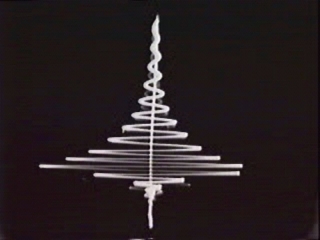
During the period that he worked for Grierson, the New Zealand kinetic artist Len Lye had led the way for some film-makers in Britain (c.1934) and Canada (e.g., Norman McLaren) into what he called direct film, in which the image was drawn or painted onto, or scratched into the film stock so that the camera might also become unnecessary. [15]
Lye was an astonishingly radical artist for someone born at the beginning of the 20th Century in Christchurch, New Zealand. He grew up in a poor family that moved a lot. He studied art, particularly drawing, in the Wellington Technical College. In 1922 he moved to Sydney, Australia, where he took a serious interest in tribal culture: Australian, Maori and Samoan, and saw Frank Hurley's documentary With the Headhunters in Papua which inspired him to join Filmads, a local advertising company that specialised in animated film. Experimenting in his own time, he learned the techniques of animation and editing. [16] He briefly returned to New Zealand, then lived in Samoa until he was deported, returned to Sydney (1925-26) and subsequently worked his passage to London where, while living on a barge on the Thames, he made his first animation Tusalava.
In the process Lye discovered the technique for making direct film animation in 1933, and described it to Ray Thorburn in a 1974 interview in New York:
“you directly etch, that is, scratch with a needle, right into the celluloid, or paint right onto the celluloid so that the color sticks to it. You can create motions under control in a sequential way which ends up looking okay. But if you also synchronize the visual accenting with sound accenting of music with say, a rhythmic beat, then you've got something you can look at. The visual image is a combination of abstract shapes wiggling around synchronized with the abstract sound or music you hear. One enhances the other, one sharpens up the other.” [17]
In a sense he was one of the earliest moving-image makers (by which I mean both film and video makers) to have attempted to produce a visual music directly onto film. As such he presages the work of the Ubu film-makers and the work of those video artists for whom synthetic video and visual music were important early forms. For his films Lye used a multitude of shapes and lines which might have been scratched, stencilled or painted onto the film surface presenting mobile geometric shapes in a flow of bright colour. Many of these elements came to stand for the sound of a particular instrument and danced or vibrated according to the kind of sound that instrument made. For example a saxophone was represented by a thick vertical line that broke up into clusters of fibres or a guitar became a horizontal line that would quiver and twang. [18]
A Colour Box (1935) consists in a background laid down with paint through a variety of dot screens of the type used in printing photographs in books plus the occasional geometric object impressed onto the surface, usually as some sort of mask to the painted background, plus single or multiple wiggling vertical lines and other squiggles painted to represent and synchronize with the timing of the instruments: percussion, string base, trumpet, piano and mandolin, played by a classic dance band of the time. Towards the end a series of frames of text announce the costs of parcel post with the British Post Office. For music, he used a piece played by Don Baretto and his Cuban Orchestra. The film was shown widely and won a prize at the 1935 Brussels Film Festival. [19]
A later GPO film, Rainbow Dance (1936) is a combination of live action and painted and scratched film. The live action is usually used as a colour mask. The film begins with rain over mountain ranges seen in pastel colours in the background. The rain is a series of diagonal lines painted on the frame. The camera tilts down to a man in a raincoat who is standing in the rain at the entrance of an ally with his umbrella held high. He is seen in flat solid colours. When the rain has stopped a rainbow appears opposite him and he closes his umbrella only to be swept away by a couple of asterisks and taken on a holiday. The man, now in holiday clothes of flat solid colours, dances and leaps over the landscape. He goes to the seaside which is made from cut-out fishes, sail-boat masks and scratched wavy lines. The countryside is seen in a series of pastels consisting of maps and then mountains followed by a tennis court, where he plays tennis and dances off into a village represented by a single house, a road that was once the tennis court paving stones, and trees at the side of the road. He then rests from all his exertion. It's all an ad for the Post Office Savings Bank, the Brighton (Beach) branch of course.
Overall, Lye sought to express an empathy between the perceiving body, the musical instruments of the soundtrack and the movement of lines, shapes and colours on the screen echoing the density and variations in pitch and harmonics of the sounds of the instruments.
Now, in the early 1960s Australia was culturally isolated but the Australian government was greatly in support of American adventurism in Vietnam and the cinema was swamped by the populism of Hollywood. The visual arts were dominated by two strongly inter-connected debates, one over style and the other over regionalism. The question of style was deeply associated with a vociferous debate as to whether Australian art was merely parochial in its realism and should thus take on a greater recognisance of international styles as represented particularly by abstraction; or whether it should be seen as a manifestation of a national identity responding to, for example, the harsh qualities of the landscape and thus maintain the figurative modernism of the Antipodeans. [20] This debate raged to and fro for many years, well into the 1980s, [21] with the leading art critic of the 1960s, Bernard Smith, arguing for the figurative and against abstraction. [22] However in the later years of that decade, abstraction made substantial inroads within Australia through exhibitions like Two Decades of American Painting that toured here in 1967 and The Field at the National Gallery of Victoria in 1968, and by journals like Studio International out of Britain.
It felt, to many outside the debates over style in painting, that Australia's isolation ought not be preserved. The so called cultural cringe [23] could only be defeated by being unself-consciously ourselves [24] thus promoting a kind of art that in its own internal strength would stand with the work of the rest of our international peers. Within the universities in Sydney, where a small group of students took an independent stance, exposure to European avant-garde traditions in theatre and film as well as experimental attitudes in architecture [25] began to produce a new experimental culture outside of the traditional visual arts. With the appearance of the satirical Oz magazine in April 1963, produced by Martin Sharp, Richard Neville, Richard Walsh and with graphical contributions by Mick Glasheen and Sharp, a confident, irreverent political and social reappraisal of the culture was launched. This was the real beginning of the 60s in Australia. [26] At the same time the university film societies were showing new animation, including the work of the Canadian animator, Norman McLaren, and Len Lye, as well as the films of the European and (by the late 1960s) the American avant-garde.
Albie Thoms and Ubu Films
Meanwhile, videotape was just becoming available in Australia in the form of the 2-inch quadruplex machine developed by Ampex in the US in 1965. Albie Thoms, who in 1965 was studying theatre at the University of Sydney and working as a production trainee at the ABC, tells his part in the story:

Fig.3: Portrait photograph of Albie Thoms (photo: Peter Mudie).
“In 1965 I was employed as a production trainee at ABC television, and I was introduced to videotape recording processes using 2-inch Ampex machines. Basically they were just using this to record programs at that stage. In the subsequent year, they acquired a couple more ended up having about four machines, but originally they only had a couple. In '66 I was assistant producer on a comedy show called Nice and Juicy. The producer was a guy named Eric Tayler who, though he had worked at the BBC for years and obviously videotaped a lot of his programs, wasn't at all au fait with videotape editing. And because I'd been introduced to the possibility of that as part of my training, I then became the person that... Well first of all, he started recording the program as a continuous run, a half hour comedy show. It was a dismal failure. It was pointed out to him that he could videotape it in segments and improve the performances and correct the mistakes and things. And because he wasn't au fait in video, and I'd just had a little bit of training, I then became the person that assembled the programs from the video segments that he recorded. And we were using the big Ampex machine, big as a bloody refrigerator almost, and we had to use 10 to zero countdowns, and there was no electronic editing.
“But it occurred to me while we were doing that, that you could go a lot further. So the following year I got one of my first directing jobs, and I was directing a TV series called Contrabandits (1967). It was a cops and robbers sort of thing. And I started recording the segments and then transferring some of the things onto a second machine and mixing them through a vision mixer back in the studio.
It was very complex, you had to get all these departments to agree, and that. But anyway we were able to remix the programs and so I could get dissolves between scenes and things, up till then it was just butt edits, right. Then it occurred to me also that I could mix the soundtrack. If I could find the time when three machines were available, I could lift the sound off, remix it and re-stripe it, right.
"So I was able to do a lot of stuff then that was new to the ABC. I suspect that other people had long before discovered it and... but basically they had a pretty conservative attitude to videotape. It was just mainly a recording device, you know. And because the two-inch tapes were horribly expensive, they were reusing them, so that they were wiping the programs. Luckily they were kinescoping some of them and some of them were preserved. But basically they had very few tapes.
"Then as the ABC's programming schedules increased, they were putting more and more stuff to air off videotape, and it suddenly became very difficult to get machine time. And that little window of opportunity closed down a bit then.
"But with that video training... I was still mainly working in film both at the ABC, and then of course with Ubu, which was running parallel to that. Then we read about the new Sony half-inch machines that were going to become available.
"But I hadn't got too excited about that, mainly due to David Perry. He reckoned that the resolution was going to be so poor that it's not going to compete with film and it's not going to... We'd actually been thinking of putting some of our films onto Super-8 and trying to sell them as home... the way they sell DVDs now, you know. But because very few people had a Super-8 projector with sound there was not much point. We'd be selling mute copies of our films and we abandoned that. And I thought maybe video is going to be the way. But David was doubtful.
"My first encounter with the actual half-inch Sony Portapak [27] was in 1969 and Phil Noyce had it at Sydney University. Sydney University had by then set up a closed circuit TV thing for lectures, and I don't know who it was who'd acquired this, whether it was the film society or whether it was the university television service. But someone had acquired a half-inch machine. And when I showed Marinetti at the law school in the city, he did an interview with me on the portapak, and then played it through the closed circuit to promote the screening. And it was much better than I'd thought in terms of quality and all that." [28]
An avant-garde theatre was also developing. While working at the ABC in 1965 Thoms was producing The Theatre of Cruelty, his review of European avant-garde theatre [29] for the Sydney University Dramatic Society (SUDS) [30]. He asked David Perry to shoot two films for him. One was a version of The Spurt of Blood, an Artaud script which required some apparently magical effects, and the other was a version of Schwitters’ Poem 25, in which a series of frames with numbers were written directly onto film stock. [31] This led to the beginning of their collaboration, with Perry shooting Thoms’ films as well as his own. Also in the production crew was Aggy Read who was the stage mechanist. Shortly after The Theatre of Cruelty performance, on August 28, 1965 [32] Thoms, Perry, Read and John Clark established Ubu Films, named after Alfred Jarry's Ubu Roi. [33]
Ubu Films became a production and exhibition group that was occasionally wildly controversial, regularly attracted the opprobrium of the Commonwealth Film Censor for the nudity and sexual freedom of their films, and variously excited and bored their audiences with an astonishing range of work. [34] However their role was not merely absurdist and subversive given that their leadership in the underground culture meant that to a large extent the period of the later 1960s became the era of experimental film in Australia. This was also stimulated by seasons like the 1967 touring exhibition of American avant-garde film, New American Cinema [35], in much the same way that Two Decades of American Painting provoked Australian visual art.[36] There were also two articles on underground films, one in Time (1967) [37] and one in Newsweek (1967) [38] that legitimised [Ubu's] work and encouraged widespread experiment. [39]
Ubu Films turned out to have been a most important development in non-commercial film-making in Australia; leading to the Sydney Film-maker's Co-op and generally encouraging the re-development of an interest in locally made films in Australia. They supported the exhibition of experimental and avant-garde film in general, distributing films offered to them by the likes of Frank Eidlitz, Ludwig Dutkiewicz and Stan Ostoja-Kotkowski [40] while also taking on Australian distribution of some of the American avant-garde film introduced to Australia through the Sydney Film Festivals and the New American Cinema program. Ubu Films ran for five years, branching into light-shows for the happenings that had become a part of the hippie scene in Sydney.
Thoms had been making his feature length abstract film Marinetti since December 1967. [41] It begins with a long sequence of black frames with an increasing number of white frames intercut every minute and a voice-over in which Thoms and others (among them David Perry, see Chapter 10) discuss the Futurists and their impact on art and many aspects of popular culture. It is almost as if Thoms is explaining his approach to the film until the white frames predominate. Gradually John Sangster's music (a strong contemporary jazz) and the chatter of a party take over the soundtrack and we are slowly, very slowly, presented with actual images as a room fills with people, at which point the film cuts to the party on the verandah of a Paddington terrace house interspersed with the occasional shot of a near naked woman relaxing as the party gets started. It was filmed hand-held and begins in a day-to-day manner with people in the Ubu office downstairs, the lounge room and the backyard of the house. As it develops it becomes increasingly psychedelic.
Since it was an Australian film Marinetti did not have to be submitted to the NSW film censor, and it premiered at the Wintergarden Theatre in Rose Bay, on June 17, 1969. A capacity audience turned up, but, being an abstract and very avant-garde film, not at all like the irreverent work of most Ubu films, it was not well received. There was an angry and negative response which resulted in a virtual riot [42] at the cinema and the press coverage over the next few days was damning. But, the film was called Marinetti (after F.T. Marinetti of the Italian Futurists) and it should have been obvious that it would not be an ordinary film. Following the premiere, Thoms showed the film in other states in Australia, and then embarked on a world tour, determined to assess international responses to the film.[43] Marinetti had pretty much worn him out.[44]
The response to Marinetti marked the beginning of the end for Ubu Films which broke up in 1970 as each of the main protagonists went their separate ways. Thoms had gone
to the US to exhibit his film Marinetti, and spent the next year screening the film in Europe, while also working for Oz, IT, and Friends magazines in London, the First International Underground Film Festival, the Wet Dream Film Festival and the Nederlandse Filmmakers Koop in Amsterdam. [45]
He ended up in London before returning to Sydney in 1970. Meanwhile David Perry finished his film Album (April, 1970) and went to live in London. Aggy Read went on to finish his film Infinity Girl (1971) which forms a major section of his Ubu diary film Far Be It Me From It (1968-72).[46] And the others began working independently. Previously, in July 1969 the Sydney Filmmaker's Co-op had been established despite a lack of support from the arts funding bureaucracy, though braced by the growing enthusiasm of many other young filmmakers. [47]


Endnotes
1 See Wikipedia on the Bay_of_Pigs_Invasion
2 See Wikipedia on the Cuban Missile Crisis
3 Mai Elliott, RAND in Southeast Asia: A History of the Vietnam War Era, A History of the Vietnam War Era Rand Corporation, Santa Monica, Calif. (2010), RAND Corporation's Herman Kahn was the source for Kubrick's 1964 film Dr. Stangelove or: How I Learned to Worrying and Love the Bomb.
4 Wiener, Norbert (1950) The Human Use of Human Beings, Boston: Houghton Mifflin.
5
See Ruskin, John, Unto This Last, Four Essays on the First Principles of Political Economy, London: Smith, Elder and Co., 65, Cornhill, 1862.
and Ruskin, John, The Stones of Venice, London, George Allen and New York: Longmans, Green, and Co., 1903.
6 See Wikipedia on the Arts and Crafts movement,
7 See Wikipedia on William Morris,
8 Paul McGillick, The Institute of Contemporary Art Central Street Gallery, Art Network, #6, Winter 1982, pp.48-49.
9 Kenyon, T. (1995). Under a hot tin roof: art, passion and politics at the Tin Sheds Art Workshops. Sydney: State Library of New South Wales Press.
10 A group of libertarian intellectuals who mostly gathered at the Royal George Hotel in Sydney. Germaine Greer and Paddy McGuinness were both members for some of its existence. See Coombs, Anne (1996) Sex and Anarchy: The life and death of the Sydney Push, Ringwood, Vic.: Viking, and
Franklin, James, (2003) Corrupting the Youth: A History of Australian Philosophy, Sydney, Macleay Press, ch.5: The Push and Critical Drinkers ,
11 Essentially an anti-Vietnam War and anti-conscription movement.
12 McLuhan, Marshall, (1964) Understanding media: The Extensions of Man,Understanding Media, London, Routledge and Kegan Paul Ltd .
13 Roszak, Theodore, (1970), The Making of a Counter Culture : Reflections on the Technocratic Society and its Youthful Opposition, London, Faber and Faber
14 Fuller, R. Buckminster (1970), Operating Manual for Spaceship Earth, London, Routledge and Kegan Paul Ltd , New York, Pocket Books.
15 Lye had lived in Sydney in the early 1920s and has said that he learned film animation in Sydney in 1921, see Lye in Film Culture 29, 1963 - "Sydney, Australia, was where I first learned animation ... [and] in 1921, I experimented with painting on film". See also Thoms, Albie (1978) Polemics for a New Cinema, Sydney: Wild & Woolley, p.77. For a short survey of Lye's animation work and interviews with him from 1963 and '67 see: Russett, Robert and Starr, Cecile (1976), Experimental Animation: an Illustrated Anthology, New York: Van Nostrand Reinhold., pp.65-71. For Lye s biography see Horrocks, Roger (2001), Len Lye: a biography, Auckland, NZ: Auckland University Press. There was an exhibition of Lye s kinetic art at the AGNSW, 1 December 2001-27 January 2002, see Annear, Judy (curator) (2001), Len Lye, Sydney: Art Gallery of NSW. Catalogue to the exhibition at the AGNSW, 1 December 2001-27 January 2002. There was a later exhibition of his kinetic work at ACMI, Melbourne in July-October, 2009
16 Horrocks, Roger, Len Lye: a biography, Auckland University Press, Auckland, NZ, 2001, pp.54-56. See the video Tusalava, with a newly composed soundtrack by Andrew Pask.
17 Len Lye in “Ray Thorburn interviews Len Lye”, Art International, XIX (April), 64-68, 1975, p.65.
18 Roger Horrocks, Len Lye: a biography, Auckland University Press, Auckland, NZ, 2001, pp.54-56. See the video Swinging the Lambeth Walk, See also “The Hand of the Filmmaker” in Tyler Cann & Wystan Curnow (eds), Len Lye, Australian Centre for the Moving Image, Melbourne, 2009, p.25. Horrocks has drawn this from Len Lye: “Notes on a Short Colour Film” in Curnow and Horrocks (eds), Figures of Motion: Selected Writings, p.28. The last sentence is a modified version of Horrocks' version.
19 Cantrill, Senses of Cinema, op cit.
20 To a large extent this was the line led by Bernard Smith in his Antipodean Manifesto, part of the catalogue for the exhibition Antipodeans held 4th-15th August, 1959 by the Victorian Artists Society. These debates are well covered in Burn, Ian; Lendon, Nigel; Merewether, Charles and Stephen, Ann (1988) The Necessity of Australian Art: An essay about interpretation, Sydney: Power Publications, p.74, note 10. See also Clark, Deborah (curator) (1999) The Antipodeans: challenge and response in Australian art 1955-1965, Canberra: National Gallery of Australia, particularly p.42 where Smith’s Antipodean Manifesto is reprinted.
21 As manifested in the controversies over Australian representation in the early (1976 and 1979) Sydney Biennales. Binns, Vivienne; Milliss, Ian; et alia (eds) (1979) Sydney Biennale - White Elephant or Red Herring : Comments from the Art Community Sydney. Alexander Mackie C.A.E. Student Representative Council.
22 Bernard Smith, The Antipodeans
23 The term was first used by A.A. Phillips in an article for Meanjin, Summer 1950. See also Phillips, A. A. (1958) The Australian Tradition, Melbourne: Melbourne University Press., p.89; See also Burn, et al, 1988, op cit, p.77 and note 1, p.84.
24 Phillips, op cit., quoted in Burn et al, 1988, op cit. p.77.
25 For example, as taught by the architect Bill Lucas at the UNSW Architecture school.
26 See the article on OZ magazine at MILESAGO - Media - Press and press the “Oz” buton in the left-hand panel.
27 It is difficult, at this point, to discover whether this was a Sony AV-3400, which is said to have been first released in 1969 (although others say 1970, see for example: Museum of vintage reel-to-reel video recorders, or a Sony DV4000 which had been released in 1967. There again it could have been the Akai 1/4-inch portapak (released in 1969) and Albie has just remembered the Sony because it became the more ubiquitous. There was certainly an Akai around Sydney University in the very early '70s because it was used to record some of Philippa Cullen's performances in 1972.
28 Thoms, Albie, recorded conversation with Stephen Jones, 27 Dec, 2010.
29 ibid, p.56.
30 Thoms, Albie (1965) The Theatre of Cruelty, programme for performances at the Sydney University Union Theatre, July 2,3, 7-10, 1965, produced by Albie Thoms. Sydney: Sydney University Dramatic Society.
Thoms, Albie (1978) Polemics for a New Cinema, Sydney: Wild & Woolley, pp.94-95.
31 Poem 25, based on a poem by Kurt Schwitters, was screened as a performance piece as part of The Theatre of Cruelty. It was a form of expanded cinema in which an actor spoke the numbers out loudly while standing in front of the film projection screen - the actor couldn’t see the film, so had to remember the string of numbers which were not in “numerical order”. [David Perry, conversation, 22/4/05.]
32 Mudie, Peter (1997) UBU Films: Sydney Underground Movies, 1965-1970, Sydney: UNSW Press, p.26.
33 Thoms, 1978, op cit, p.79.
34 Mudie, 1997, op cit.
35 New American Cinema toured with Two Decades of American Painting and was shown in the Qantas Theatrette, Sydney, in July 1967. It featured films by Stan Brakhage and Maya Deren [Mudie, 1967, op cit, p.71; Lawson, Sylvia (1967) The Personal Film in The Nation, 112, August 1967].
36 New American Cinema was shown in association with Two Decades of American Painting at the AGNSW [Rasmussen, 1967] which offered a rare opportunity for the public to see Abstract Expressionist, Geometric Abstraction and Pop Art paintings by well known American painters. The show was sponsored by the Museum of Modern Art (MOMA) in New York and supported in Australia by the US Information Service and the US Ambassador. It was at about this time that the journal Encounter was exposed as being funded by the CIA and this led many to argue that the presentation of these exhibitions were supported by CIA funding. Such arguments were of course dismissed as Conspiracy Theories. However, in a well documented book first published in 1999 and reprinted recently, Frances Stonor Saunders’ Who Paid the Piper: The CIA and the Cultural Cold War (London: Granta Books), the author argues that the CIA were deeply embedded in the organisation and funding of many cultural agencies (especially the Berlin based Congress for Cultural Freedom) during the Cold War and that the MOMA was chief among these, under its patronage by Nelson D. Rockefeller. As the funding for Two Decades of American Painting originally came from the MOMA and the Rockefeller fund it seems reasonable to suppose that this exhibition was also part of the US foreign policy campaign covertly funded by the CIA. See Frances Saunders’ The Cultural Cold War: The CIA And The World Of Arts And Letters, The New Press (2013), or Louis Menand’s Unpopular Front: American art and the Cold War& rdquo; in New Yorker, 17 October, 2005,
37 “Art of Light & Lunacy: The New Underground Films”, Time magazine, February 17, 1967, pp.57-60, (no byline).
38 Kroll, Jack, (1967), “Up From the Underground”, Newsweek magazine, February 13, 1967, pp.49-51.
39 Thoms, email, 3/5/06; Mudie, 1997, op cit, p.56.
40 Peter Mudie, op cit
41 Peter Mudie, 1997, op cit, p.59. Mudie lists Ubu’s Experimental Film and Underground Movies, at the Union Theatre (University of Sydney), March 19, 1967.
42 Thoms, 1978, op cit, p.82.
43 Ibid.
44 See Thoms, 1978, op cit, pp.94-98 for the full story of Marinetti. Also see Mudie, 1997, op cit, numerous pages.
46 Ibid.
47 Mudie, 1997, op cit, pp.13-17; p.74.