Chapter 8
The Cantrills and TVX Australia
Arthur and Corinne Cantrill, who had been living in London since 1965, returned to Australia at the end of April, 1969. [1]
They had been making films together in London and were drawn back to Australia (where they were both born) when “Nugget” Coombs offered them a Creative Arts Fellowship at the ANU to make experimental films and give lectures in the history of avant-garde film. Their first screening in Australia was at the 4th Brisbane Film Festival (May 3, 1969) where they showed Moving Statics (1969). Ten days later they showed a collection of their London films in Sydney at a screening arranged by Ubu Films. They then took up the Fellowship in the Creative Arts at The Australian National University, Canberra. On June 26, 1969, they showed Robert Klippel Junk Sculpture (1964), Kinegraffiti (1963), The Incised Image (1966), Dream (1966), Moving Statics (1969), Red Stone Dancer (1968), and Imprints (1969) at an ANU Film Group screening in the Coombs Lecture Theatre, Canberra. [2] They also ran several weekend courses on the History of Avant-Garde Film and began working in Expanded Cinema. Their first actual Expanded Cinema screening appears to have been “Get Your Eyes Open! – Expanded Cinema”, which premiered White-Orange-Green (1969) as a 3-screen work at the Childers St. Hall, ANU, Canberra, on February 26, 1970. [3]


|
The primary work for the fellowship was to be their monumental Harry Hooton, a celebration of the anarcho-technical philosophies of the radical Australian poet, who died in 1961, that were perhaps best expressed by Hooton as “the application of emotion to matter”.[4] They worked on Harry Hooton for most of the year and it was premiered, along with 4000 Frames (1970) and Earth Message (1970) at the Canberra Film Society and the ANU Film Group at the ANU on September 2, 1970. Along with other films of theirs, Harry Hooton was then toured around the country to tertiary institutions and film societies over that September. There was another screening at ANU in Canberra, October 16, 1970 at An Evening of Expanded Cinema which included the 3-screen films: Fragments (1971), Gold Fugue (1971), Room (1971), Pink Metronome (1971), The City (1971) and outdoor events: The Burning Screen and Water Projection, at Childers St. Hall, ANU. [5] Many of the soundtracks for these films were produced as electronic music by Arthur Cantrill himself. |
Meanwhile, a little earlier in Melbourne, Fred Harden and several friends had set up
“screens at an arts group who used one of the church halls in North Carlton. [They] allowed everybody to use the place for creative things... We used to have two screens and it was films that I got from the National Library. And I just picked things that people could get stoned to, and John Whitney's Lapis was one. It was quite a good group because there were poets and all kinds of things happening … and at the same time I was talking with somebody like Peter Tammer or Jim Wilson who were friends of Bert [Deling] and Sasha [Trikojus] because they all used to go down to Lorne where Jim's parents had a place. And he, they all... I don't know whose idea it was to say that you, we, they, should form a local co-op. Sydney had started. And we decided that I should put out a little flyer that was to say who's interested in forming the Co-op [c.1970]. The next thing; we were in the Pinacotheca art gallery [Richmond, Victoria] and it was a done deal. As Harden notes the gallery wanted to have us there. So we put in a big screen and speakers and all that stuff. Pinacotheca gave us a home.” [6]
“Bert and Jim came in with friends that they knew from university and they seemed to be the big kids, and I just felt I was an enthusiast rather than anything else and it didn't really develop until we then moved through that process of showing at the art gallery. I didn't really know what kind of films I wanted to make, I was just making personal diary stuff, and when Gene Youngblood's Expanded Cinema hit, all of a sudden... we could see all these things happening and because I was working in advertising and knew where the technology was going there, it seemed like this was still well how advanced was America, Oh we'd never have the chance to do it here and there seemed to be a degree of delay before it did happen here. There were a few things that happened technically with Super-8 at the time that kept us in that area of the arty mucking around. Then those people who were working in social realism wanted to do documentary, wanted to be using it as... that whole business of things where you were telling the story of the people who had been displaced from the block of flats. [7] Now that sort of stuff seemed to be enough for those people, they were quite happy to tell those stories. We were still dicking around with the arty bits. [8]
Within the year the whole thing
“became formal and we actually had a Film-makers Co-op. What it did was basically draw in all those people that had been involved with film-societies and things and Swinburne Film School people, and Paul Cox who was teaching at Prahran College and encouraging his students to do films, the Carlton scene with the guys who were seen as the old guys, they'd been around for a few years by this time, they'd still come and we would do things like show retrospectives of Tim Burstall, and it was just nice having that community thing happening there. It was a good spot. The screenings were not very well structured. But when they started to be structured the whole thing changed. I think we asked for a donation, I don't think we'd had a door fee except in some cases where the films had come down from Sydney and we had to charge two dollars or something.” [9]
Harden had been producing a small periodical called Filmnotes which he sold at Co-op screenings.
“The Co-op was the first place that I sold copies of Filmnotes, duplicating them. I did three issues or something and they had a photocopied cover. I did it because at Clemengers we had a system that was good for proofing ad artworks, and you'd put it down on the light table, it was a reversal process I think, and fed it through processing rollers holding up a standard newspaper sized sheet. So this was great, this was poster material and if you actually went and fixed it, processed it, so that you actually put it through the fixing bath it lasted. But in most cases it was a good place to do quick copies, flyers, program notes and all those kind of things.” [10]
Somewhere during this period Harden met the Cantrills. “I think Arthur turned up at a film co-op screening, that was the first time.”
Fred Harden's Filmnotes were the precursor to Cantrill's Filmnotes. Arthur and Corrine later asked “Can we use the name Filmnotes?” and I said “Sure”. Cantrill's Filmnotes began in 1971 “so it would have been just before that. They started to show [at the Co-op] and then why we left Pinacotheca, I don't know. It was almost like it was, probably, a “them and us” kind of split. But I cannot think who the “them” and the “us” would have been.” [11]
The Co-op moved to a building that
“used to be the Hungarian Social Club building. It was a lovely building because it was full of little rooms and things. They used to use it for their social occasions. We rented it from them for virtually nothing... It had a really big space downstairs coming in off the street, and then two levels upstairs where we had the theatre and we had a space in between where, at the times people were showing things in the theatre, the guys with the Super 8 who didn't want to be part of it, or the video when it first started, would set up. So the idea was that you could wander from one to the other.”
Having finished their Fellowship in Canberra around the end of 1970 the Cantrills moved to Melbourne. In January 1971, along with Harden and the performance poet Garrie Hutchinson, the Cantrills began a series of eighteen Sunday evening “Living Cinema” screenings at The Maze (a Melbourne music venue), which allowed them to explore and widen their idea of “Expanded Cinema”. Their stated aim with these events was to create suitable environment[s] for screening new cinema, experimental projection: mixed media, expanded cinema, etc., with participation of audience, poets to bring a live quality of unpredictability. They wanted to “explode the myth of the flat white screen by screening onto patterned shaped screens with live sound, voices, concrete poetry. [12]
In these screenings they used an increasing range of techniques for projection, as well as video. Much of the sound for these events consisted of Garrie Hutchinson's live poetry and other commentary. Some examples include, in the second evening (31 January), Meditation in which they used animated colour discs projected with an out of focus projector, and The Blast Manifesto, an animated screen collage of blown-up elements from the magazine BLAST originally produced by Wyndham Lewis in 1914 and 1915. [13] The third evening (14 February) included Mud One, a film of bubbling mud to an anti-war poem and Hutchinson's Newsreel, a collage of newsreel footage. [14]
There were several video performances at that screening, including an extended version of BLAST, with animated images from the Wyndham Lewis work projected onto Garrie Hutchinson's face which was then videoed and played back through the monitors as he read the BLAST manifesto. Another work at this screening was T.V.GRAFFITI which is described as a video of graffiti and poster poems drawn on a projected image of Bob Hawke and seen on monitors as, live, G.H. [Garrie Hutchinson] improvised a particularly obscene Hawke interview to the film. [15] This was followed by HARRY HOOTON SEEN ON TV! In which pre-recorded stills of Hooton [were displayed] on the TV screens, with (I assume) Hooton's voice narrating WOMB TO LET, with war footage on a film screen. [16] Harden also did a live video piece in which he explored the creative potential of monochrome video distortions and video feedback to the accompaniment of electronic music. [17]
Then in March 1971 they started to produce their more or less monthly journal Cantrill's Filmnotes. It was, and still is, an immensely valuable reference for keeping track of expanded cinema, 16mm film and early video art experiments at various stages of their development, not only in Australia but from around the world. They kept many experimental film- and video-makers in Australia up to date not just with their own work but with notes and interviews and descriptions of works that were being produced around the world, although usefully there was a strong emphasis on the Australian scene.
Cantrill's Filmnotes record several early uses of non-broadcast-standard video in Australia. In an article “The Video Revolution” from issue no.4, July 1971, they refer to a closed-circuit videoservice [18] known as TVX and operated by Albie Thoms, Aggy Read and Phil Noyce, [19] at The Odyssey rock festival held at Wallacia, in NSW, from 22nd to 24th January, 1971. [20] This appears to have been the first use of video in the community access model that was later adopted for the Aquarius Nimbin Festival in 1973.
TVX
Thoms had recently returned from the UK where he had participated in the British film and media scene. In the late '60s the UK was awash with the experimental: lifestyles, art (Op art, Pop art and exhibitions like Cybernetic Serendipity [4]) music with the Beatles, Led Zeppelin, Cream, Jimi Hendrix, etc, the big rock festivals, e.g., the “Isle of Wight” and Bath and magazines like Oz and International Times.) Much of the law that supposedly held decent society together was under challenge particularly spearheaded by the Oz magazine obscenity trials. Australians were everywhere, Richard Neville and Martin Sharp publishing Oz, Albie Thoms was touring Marinetti to the filmmakers co-ops in London and Amsterdam, David Perry was teaching film and video at Hornsey Polytechnic; John Kirk, later one of the members of Bush Video, joined up with the original TVX in London, which through the early 1970s enjoyed an important role in establishing community video activism and video art in the UK with the Fantasy Factory set up to replace TVX.
As I have described in Chapter 5, TVX was a video co-operative set up by John “Hoppy” Hopkins and Cliff Evans in London in 1969. [5] They had equipment that had been inherited from the Beatles, including a Sony Video Rover, and a 1-inch Ampex recorder that was semi-portable (you could put it in the car and move it from place to place. [6]) TVX were involved in video shoots of several of the big rock festivals (Bath [7] and Phun City, [8] 1971), a colour experimental program for the BBC called Videospace (1970) which was never transmitted, [9] the invasion of the David Frost program when Jerry Rubin was interviewed, a book launch for William Burroughs and various art projects including working with Wolf Vostell in Cologne. [10] They also intended to set up a monthly video news magazine to be called the Electric Newspaper which would operate as a live information/distribution/news/message service at pop festivals and other large gatherings, using projection screens and monitor chains. This section of activity is to be run in conjunction with BIT information service and Friends magazine. [11]
Albie Thoms had attended the Isle of Wight festival (1970) in the UK and had organised a daily news-sheet there called the Freek Press with other expatriates, including the Oz magazine people. On Albie's return to Australia, David Elfick invited him to produce a similar daily news-sheet at The Odyssey Festival (at Wallacia, near Sydney, January, 1971) [12] on behalf of Go Set magazine (published by Elfick). Thoms and Mick Glasheen were talking about what TVX was doing, and Thoms commented that “I'm pretty sure he suggested that I check out the Akai quarter-inch system. Or he'd just heard about it, or something. And we decided we'd try and do something for the Wallacia Festival, which was end of January 1971.” [13]
With money raised from local record companies they acquired several typewriters and a Roneo printing outfit to set up and publish a daily newspaper called Rubbish, which Thoms, with help from Aggy Read and others, edited and printed in a tent at the festival. [14] They also borrowed an Akai video portapak from the local Akai company who had recently released their portapak in Australia. Mick Glasheen had suggested this to Thoms so that they could gather stories for Rubbish from people at the festival. [15] Thoms comments:
“I approached Akai and they were very happy to loan us a camera and a monitor and a recorder. So parallel to providing the newspaper service, we decided to have the video thing, which I'd talked about having with INK, you know. This was a live thing. It was quite pathetic what we did, really. We just interviewed people at the festival, got their opinions, played it back on the monitor outside our tent where we were producing the newspaper. Anyone wandering past could look at it, but we didn't have any way of putting it... didn't have any broadcast system. So yeah, it was a very rudimentary sort of thing." [16]
“Mick Glasheen, Aggy Read, Phil Noyce, maybe Jonny Lewis, went out [17] and gathered the reportage, interviewing everyone from organisers, performers and festival-goers to the police. The video was then played back in the tent as the TVX Video News Service (they adopted the name TVX from the British version) and it also provided info for stories in the paper.
“We didn't have much tape, I think we were re-using the tapes, but it just gave us a glimmer of the possibility of what you could do with that. In that sense it was like a prelude for Nimbin.”[18]
Sadly there doesn't appear to be any tapes surviving from it. However there is a description of TVX in the Rubbish news-sheet:
“at the Rubbish tent you will also see TVX's portable video system keeping an up to the minute record of events at the festival and playing them back instants after they have happened. RUBBISH reporters are going about the festival making interviews and bringing them back to our tent for replay. If you see TVX in action go and talk to the reporters and help record the action. Portable video is accessible to all, and many of today's tapes were recorded by festival freaks themselves.” 19]
As Albie noted
“So you could really trace it back to the English TVX, you know, as the inspiration, and then Mick's enthusiasm for video and all that added in.”
Cantrills' VideoCinemaPoetry
In their article “The Video Revolution”, in Cantrill's Filmnotes (no.4, July 1971), the Cantrills mention several other events. One of these was what sounds like an utterly chaotic and anarchic expanded cinema and performance event: VideoCinemaPoetry, at “The Maze” in Melbourne on 18th April 1971, which was part of the Cantrill's Living Cinema evenings.
Arthur Cantrill in his article “Cinema Poetry” mentions that using the Akai recorder they showed pre-recorded visuals, films, stills and Gary Hutchinson events (BLAST and BOB HAWKE, etc) and live video which related or conflicted with the simultaneous live action and films replayed over three monitors along with the film projections, so as to set up a conflict between the 'hot' and 'cool' media, and let them fight it out together. [20]
And Harden adds:
“And I would have lugged in what monitors we might have had available from Clemenger's.”
One particular event, VideoCinemaPoetry, is described in some detail in Cantrill's Filmnotes #3, (pp.9-14):
“Prior video recordings of films, stills and G.H. [Gary Hutchinson] events (BLAST and BOB HAWKE etc)
Live event plus film projection combined with video replay on 3 monitors of pre-recorded material. Also event shown live on the monitors, plus film.
Aim: to set up a conflict between the 'hot' and 'cool' media, and let them fight it out together.
BLAST: G.H.'s face, VTR (with BLAST film playing on his skin and reading manifesto) played back on monitors while film screened and live G.H. reads manifesto (conflict as two voices lose synchronization)
TV GRAFFITI: A VTR of graffiti and poster poems drawn on projected image of Hawke seen on monitors as live G.H. improvised a particularly obscene Hawke interview to the film.
HARRY HOOTON SEEN ON TV! pre-recorded stills of Hooton an TV screens, voice narrating WOMB TO LET, with war footage on film screen.”
Harden, who was instrumental in starting the Melbourne Film-makers Co-op, also worked with the Cantrills on a variety of projects.
“I helped them because they came to the Co-op all the time. I got to know them.”[20]
“We were doing live events, mostly at Arthur and Corinne's Sunday evening salons which they held at their house in Brunswick St. Arthur filmed some stuff off the screen and I took photographs. Arthur borrowed the half-inch mains deck from school and we would use that as the image source and shoot the monitor image. We would then use magnets, feedback and record that off the screen, play it back and do it again. There wasn't much rigour, we were just excited by the process. Most of the art came from the film we took, superimposed, step printed. We were learning about the technology. We'd back the horizontal and vertical sync off so there was scrolling and tape that, feeding the result back.” [21]
This led to expanded cinema/poetry/video events at “The Maze” on the Sunday nights.
“It was definitely a better room to video in. I think we might have had a couple of monitors at one stage. And that's the thing of... I'm not watching the big projector screen, I'm concentrating here, or I can see that one over there.” [22]
Arthur Cantrill in an article discussing “The Video Revolution” mentions that
“Using the Akai recorder they taped and replayed material over three monitors which related or conflicted with the simultaneous live action and films.” [23]
BLACK
BROW
BROW
HOW
WRACK
NOW
ROW
COW ?
SACK
NOW
“Also screened film of coloured flames audience given sparklers to wave, which were picked up live by video camera pattern traces on video screens as bright points of light burnt in to cathode ray tube. In same event Benny Zable added dimension of skilled dance movement flames leaping on his transparent flowing garments.
“Benny Zable directed audience involvement in horizontal film waves of silhouette forms: heads, arms, hands as audience made shadows on screen against the blue, green, yellow wavelike animated images. Beautiful.
Finally Harden showed some creative work possible with b&w video distorting the image to increase contrast and texture, the texture-patterns in constant, surging movement. He also made rotating patterns spiral into infinity by directing the video camera at the monitor screen, the visual equivalent of acoustic feedback. The display was accompanied by electronic music. [25]

Fig. 2: Frames from a proof sheet of distorted images of Arthur Cantrill
produced by Fred Harden in working towards Arthur Cantrill's Video Self-Portait.
[Courtesy: Fred Harden].
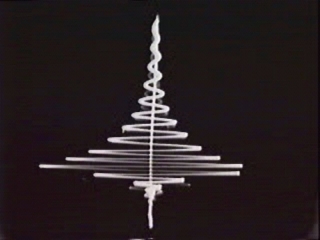
These heavily distorted photographic video portraits made by Harden can be seen in issues 3 and 4 of Cantrill's Filmnotes. From these experiments at “The Maze” Cantrill and Harden produced Video Self-Portrait (1971), a “videographic film in which images recorded on the video recorder were played back onto a monitor and filmed using colour filters, superimpositions and film-speed effects.” [Fig.1] Cantrill described it:
“The film begins with a pulsing, surging pattern of red phosphor-texture which is interrupted by an intensely cold blue/white rising image. The face of the filmmaker is superimposed and goes through a series of colour and texture transformations, until the pulsing electronic patterns obliterate the face, giving way to convoluting superimposed spiral forms produced by feedback.” [26]
Video Selfportrait, is described as
“A 6-min. videographic film exploiting the phosphor textures on the cathode screen. Video images are filmed, filter-coloured and supered in the camera.” [27] It was made by Arthur Cantrill in collaboration with Fred Harden who used the Akai portable video-recorder, displaying its output on a TV monitor. It is filmed off the monitor with the live video image coloured by filters in the film camera.”
“Superimpositions were also added in the film camera, the speed of which was varied during filming. The film begins with a pulsating, surging pattern of red phosphor-texture which is interrupted by an intensely cold blue/white rising image. The face of the filmmaker is superimposed and goes through a series of colour and texture transformations [and off channel TV noise] until the pulsing electronic patterns obliterate the face, giving way to convoluting superimposed spiral forms produced by feedback.” [27]
Cantrill and Harden were experimentng with distorting forms and textures of the image by unorthodox wiring (e.g. connecting the RF converter on the monitor to the frame of the video recorder.) As Harden comments
“By discovering these exciting images, we're being truer to the basic medium, instead of trying to reproduce a perfect photographic likeness. By exploring these techniques I'd like to go in an abstract direction: I'd like to get to a stage when I could synthesize colours, just put them down, feed a tone into it, break up the patterns. I'd like to use it in a purely electronic way, equivalent to electronic music: lights and colour and patterns.“ [28]
Interestingly, Harden is proposing something like a video synthesiser which was, at that time, only just beginning to appear in the U.S. with Eric Siegel's Colorizer [29] or Nam June Paik and Shuya Abe's “Paik-Abe Video Synthesizer”. [30] Later in 1973 video feedback, computer-generated animated patterns and the Cox Box colouriser were in use by members of Bush Video and other “video-freaks” in their more abstract/experimental video works.
I asked Harden how much he and the group gathered around the Cantrills were aware of any of the video work that was going on in Europe and America at the time, and he commented:
“Yeah, we kept up with the overseas stuff (copying when we could). Whole Earth Catalog introduced us to a lot of material. I had a library (still do) of Radical Software mags and the big buzz was Gene Youngblood's book Expanded Cinema. We didn't have any original tapes of their work at the time, it was easier to get the 16mm film copies. It was a very exciting period as the tools looked to becoming more affordable.” [31]
Harden has also told me that he and Jim Wilson had bought an Akai 1/4-inch portable VTR.
“Jim Wilson and I shared the cost of the Akai. We bought it. Jim did more with it than I did. It went out on a few things with Bert [Deling] to do rehearsals and mock up things and whatever. [Regarding] its use as an actual tool, I lent it to Jim Clayden a few times and he did stuff, most of which he was re-filming from the screen. So he would play the video and then use it for superimpositions and transitions... and we sometimes did quite a lot of that. So he would play the video and then... you know we did a few of those things, when we changed over to Super 8, where you could rewind the cassette and you could get a transition or a superimposition or whatever, and we sometimes did quite a lot of that.
“Also the video format tended to be used because we could record audio and synch it. This was the audio side of synching to camera and that became essential when you wanted to do anything documentary.” 32]
The FilmNotes article also reports work by several other filmmakers based in Melbourne at the time. These include a video interview with Richard Alpert [33] produced by Bert Deling and Sasha Trikojus. Alpert (aka Baba Ram Dass) was an American psychologist and self-styled guru who helped run the Harvard experiments on LSD with Timothy Leary in the 60's and a significant figure in the hippie ideology of spiritual exploration. Other notes cover Jim Wilson, also in Melbourne, who found that the synchronised sound and image of the portapak gave an exactly duplicated slice of life recorded in slices of real time suggesting that he could make a personal video diary of his life. [34] He proposed that it should then be possible to synthesize
“innumerable different types of images through mixing. It's not only the 'slice of life', it's not only the immediate replay, but the possibility of being able to see an endless number of images, and see the result of synthesising them together, even if a lot of the images were film image initially. I'd like to use the facilities of a video mixing studio and just edit, in a synaesthetic way, because in that way you can do the collage format much better, you get a quick positive result: if you don't like it you can start again without losing any material, and then you can build on it. To be able to see at once, say, the effect of 4 or 5 images superimposed on top of one another, and being able to vary the relative importance of one image or another.” [35]
He goes on to comment that:
“Just as Moog synthesizers gave possibilities to the electronic composer: he is responsible for the entire composition and performance, without relying on musicians. So you maybe able to do the same with images: collect all the images with the most simple camera and use an image synthesizer to combine them.” [36]
I have not yet found any of his video material to see whether he achieved what he was proposing but the suggestion is not unlike what Glasheen was doing in just such a mixing studio with his video Teleologic Telecast: On Board with Buckminster Fuller.
So far video was primarily an aspect of experimental art, but pursued by film-makers and architects. Albie Thoms has suggested that the trend to abstraction in film came out of the development of abstraction in painting and electronic music. [37] However I argue that it was the hand-made films of Len Lye and Norman McLaren that led the way, beginning with Lye's A Colour Box (1936) and Trade Tattoo (1937). [See chapter 1] Nevertheless, the increasing availability of international magazines such as Studio International, as well as the London editions of Oz, the psychedelic scene with its happenings and lightshows, and local TV programs like GTK on the ABC [38] also helped the experimental culture embrace the more Pop oriented aspects of the art world. But the fine art world seemed to be somewhat insulated from it, although that is more a view that one gains by looking back at what it was doing rather than what would have been the view held by individuals living the culture at the time. The main interests among curators for 1968 and 1969 seemed to be kinetic art and hard edge abstraction which burst on the Australian scene between 1967 and 1969 (for example in The Field at the NGV in 1968). But for the artists for whom strong political positions were also important, conceptual art was the prime focus. Thus video and the other experimental forms were not particularly embraced although where they might assist in the expression of other work they were accepted. This applies particularly to Mike Parr and Peter Kennedy at Inhibodress.


Endnotes
1 See the Cantrills' CV. [retrieved 09/11/2025].
2 ibid.
3 Cantrill's Filmnotes, no.4, July 1971, The Video Revolution , p.(2). To call it closed circuit seems to me to be something of a misnomer. Closed circuit means that there is a continuous direct connection between camera and monitor as in a surveillance system. Nevertheless there was no editing and the material gathered with the portapak was brought back to the tent and played back there to a single monitor for whomever happened to be around. There was no cable distribution as was installed at the Aquarius Festival in Nimbin in 1973.
4 Cantrill's Filmnotes, no.4, July 1971, The Video Revolution , p.(2).
5 Millie Stein: Interview with Corinne and Arthur Cantrill. [retrieved 11/01/2017]
6 Cantrills' CV. [retrieved 09/11/2025].
7 Conversation with Fred Harden at his place in Melbourne, recorded 18/01/2017.
8 For example Hughes: Hughes_Community Video_Video Exchange (JH, LE '73-4).pdf, available from WHERE?? re: John Hughes < https://www.innersense.com.au/mif/hughes.html >
9 Conversation with Fred Harden at his place in Bungendore, recorded 16/04/2006.
10 ibid.
11 ibid.
12 Cinemapoetry , Cantrill's Filmnotes, no.3, May, 1971, p.9. Interestingly it wasn't long before this that painters had started to use non-rectilinear and definitely non-flat canvasses in painting. See for example the work of Ian Milliss as discussed in an earlier chapter.]
13 Wyndham Lewis, BLAST, 1914, 1915. < https://https://en.wikipedia.org/wiki/Blast_(British_magazine) >
14 Cinemapoetry , Cantrill's Filmnotes, no.3, May, 1971, p.9.
15 Cinemapoetry , Cantrill's Filmnotes, no.3, May, 1971, p.11.
16 Cinemapoetry , Cantrill's Filmnotes, no.3, May, 1971, p.13.
17 Cinemapoetry , Cantrill's FilmNotes no.3, May, 1971, p.14.
18 The Video Revolution , Cantrill's Filmnotes – no.4, July, 1971, n.p.]
19 Rubbish: Pop Festival Community Paper, No.2, 23rd January 1971, p.2.
20 Harden, recorded conversation, 18 Jan, 2017.
21 Fred Harden, email, 12/4/05.
22 Harden, recorded conversation, 18 Jan, 2017.
23 Cantrills Filmnotes, no.4, July 1971, The Video Revolution , p.(8)
24 Harden, recorded conversation, 18 Jan, 2017.
25 Cantrill's Filmnotes, no.3, May 1971, Cinemapoetry , pp.10-14.
26 Cantrill, Arthur - paragraph headed Videographic Cinema in The Video Revolution Cantrill's FilmNotes, no.4, July 1971, p.(8).
27 Harden, email, 12/4/05.
28 Fred Harden, recorded conversation, 18 Jan, 2017.
29 See Eric Siegel's vsynths < http://www.audiovisualizers.com/toolshak/vidsynth/eric_s/eric_s.htm > retrieved 11/01/2017]
30 See Paik-Abe Video Synthesizer < http://www.audiovisualizers.com/toolshak/vidsynth/paik_abe/paik_abe.htm > retrieved 11/01/2017]
31 Fred Harden, recorded conversation, 18 Jan, 2017.
32 ibid.
33 For a biography of Alpert: http://www.ramdasstapes.org/biography.htm
34 Wilson, Jim - paragraph headed Personal Video in “The Video Revolution”, Cantrill's Filmnotes no.4, July 1971, pp.(3)
35 Wilson, Jim - paragraph headed Synaesthetic Video in “The Video Revolution”, Cantrill's Filmnotes no.4, July 1971, p.(4)
36 Ibid, p.(5).
37 Thoms, conversation, 18/3/06.
38 Which began in August 1969. Later Thoms did a stint as a director for it.