Chapter 9
Stanislaus Ostoja-Kotkowski
Now, regarding the synthetic image we should recognise here that by 1962, the immigrant Polish artist Stanislaus Ostoja-Kotkowski had begun his investigations into electronic drawing.
Electronic Drawing
Ostoja-Kotkowski was born in Poland in 1922 and studied painting and drawing during WWII. In 1946 he won a scholarship to study in Germany at the Academy of Fine Arts in Dusseldorf, which continued the traditions of the Bauhaus. He studied there until he emigrated to Australia in late 1949, and furthered his studies at the National Gallery School in Melbourne, from 1950-52. [1]
During 1954-55 he worked in Central Australia [2] which he has said, in a 1968 conversation with the art critic Laurie Thomas, had a profound effect on him:
“The terrific iridescence you can get behind the eyes in Central Australia forces you to think of the source of light whether it’s beam, lantern or sun and to think of it as the most impressive, most flexible and richest tool imaginable for an artist. The life giving source. ... Why couldn’t a painting change its shape, form and color? ... It seemed to me that you could achieve this by by using light as a tool and that the closest thing to the source of light we know and can handle confidently is electronics. [3]
Subsequently, as Thomas records
“He began playing with one of those early television sets with plenty of knobs, creating contracting shapes, rolling them, twisting them, watching the dizzle-dazzle effects between the snow, the flashing patterns. [4]
“These experiments led to his interest in electronic images and to his first development of a means of electronic painting [5] by photographing the manipulated television image. He found he could introduce extra contrast and put the picture out of alignment and out of synchronisation but he wasn't modifying the electronics at this stage. He says he got some superb images, and thus his drawing with light began in drawing with electrons on the phosphor of the TV tube. [6] However, he was seeking some kind of pure image, the distorted broadcast image being unsatisfying, so he went looking for a way to control his own orchestra of light and shape.” [7]

Fig. 1: Stan and Malcolm Kay at a TV set with manipulated deflection coils. [Courtesy: the estate of Ostoja-Kotkowski]
In 1962 he persuaded Malcolm Kay, an engineer at the Philips Research Laboratories in Hendon, South Australia, to build for him a device that could alter the deflection waveforms and thereby the electromagnetic fields driving the electron beam in the TV picture tube so that the raster could be curled and shaped into planes and volumes, producing almost sculptural forms on the screen.[8] These first images were shown at his Argus Gallery, Melbourne, exhibition in July 1964. Ostoja-Kotkowski's photographs from the TV screen show a heavily distorted raster, with what might have been elements of broadcast images but they were not particularly interpretable as such, being more slewed angular blobs or more-or-less random collections of lines across the image. They were quite different from Paik's television images in which the broadcast pictures were live and still recognisable, if distorted, with faces and scenes still clearly readable. [9]
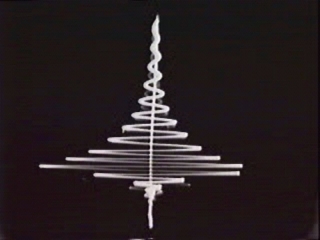
Later images from Ostoja-Kotkowski's raster manipulation synthesiser became more sophisticated and better controlled as the device was refined. They were far more pure, almost op art forms made up of carefully grouped arrays of (raster) lines, bent into graceful curves and sprays. In 1966 they graced the covers of Meanjin Quarterly. [10] [Fig.1] But they were all abstract images formed from pulling the scan-lines of the TV magnetically towards a point or drawn together into a cascade yielding a loosely woven surface of bright lines sweeping and curling across the screen. He predicted that the artist would be able to control the form of the electronic images as much as with painting, even though this may be restricted by temporary technical short-comings .[11]

Fig. 2: Four Electronic Drawings by Stan Ostoja-Kotkowski. Scanned from the covers of Meanjin, vol.25, nos.1-4. [Courtesy: the estate of Ostoja-Kotkowski]
As I have already suggested, this work is of some importance when we look at what else was going on worldwide, in what, at that stage, was often considered merely a form of engineering experiment or, when produced by already established artists, as installation-cum-happening a la Fluxus. Several animators, Mary Ellen Bute (US),[12] Norman McLaren in collaboration with Evelyn Lambart (Canada), particularly in their film Around is Around, [13] and Hy Hirsh (US) had been using oscilloscope imagery in their work as long ago as the early 1950s.[14] However the best known artist’s work using the oscilloscope was that of Ben Laposky (US) who constructed and photographed elaborate Lissajous figures that he called Oscillons or Electronic Abstractions made using waveforms from an analogue computer and displayed using an oscilloscope.[15]
Laposky was producing electronic images in the form of Lissajous figures which could be thought of as similar to what Ostoja-Kotkowski was producing, however it was through the simple injection of audio waveforms into the X and Y inputs of the oscilloscope. Ostoja-Kotkowski’s electronic drawings, as he called them, were generated with a device that directly manipulated the beam deflection in the TV set using audio waveforms as the manipulation signals, not unlike an oscilloscope, but they were more than simple Lissajous figures given that the raster, and sometimes the video image, were still more or less intact. From a description in an article titled “Electronic Images” in the magazine Camera World International, the author (signed only as K.L.A.) quotes Ostoja-Kotkowski:
“When making electronic images, the black and white intervals used come from broadcast television programs or from square wave and sine wave generators. The timing of the lines is adjusted by hand after disconnecting the normal synchronising circuitry. The shape of the picture can also be controlled by magnetic fields. A permanent magnet, or more conveniently, a D.C. electromagnet, can be used to bend parts of the picture, whilst an A.C. electromagnet supplied with current at picture repetition frequency (frame frequency), can be used to form swirls and folds, the nature of the shape depending on the phase angle between the magnetic field and the picture repetition frequency.” [16]
Nam June Paik is generally thought of as the first to manipulate the video display using both permanent magnets and electromagnets, the latter initially through the use of a degaussing coil, to twist and distort the raster whether it was blank or had some sort of television image with it, though this was not done until 1965 with the work Magnet TV [17] He had previously manipulated the internal electronics of the TV in the 1963 Exposition of Music - Electronic Television exhibition in Wuppertal, but these were essentially static or permanent effects and could not be played in any sense, although one of the pieces was a work called Participation TV in which a microphone was used to drive the deflection coils creating an explosion of dancing lines in the centre of the screen. In 1966 Paik presented a series of what he called Dancing Patterns in which he added a third coil of wire around the neck of the CRT and used audio power amplifiers fed with sine-waves to form Lissajous figures that gave an extra degree of freedom by which the regularities of the usual sine-wave based Lissajous figure were further distorted by a signal being applied to this extra coil. [18]
It is also generally considered that Paik was the first to build a playable image manipulation device that could be used live in the making of a television program, however Eric Siegel's Processing Chrominance Synthesizer (PCS) [see, for example Einstine] preceded the Paik-Abe Synth, having been built in 1968, (see above). It wasn’t until 1969-1970 that Paik built (with Shuya Abe) his first video synthesiser, essentially a colouriser and usually accompanied by a raster manipulation device. [19] It was built for, and used live during, a television production called Video Commune produced in 1970 by WGBH Boston. [20] However the accolade of first to build an image synthesiser probably belongs to the Computer Image Corporation and their Scanimate device, which grew out of work begun in 1962. [21] Ostoja-Kotkowski’s machine for producing “Electronic Drawings” (also begun in 1962) fits in between the figure animation precursors of the Scanimate and Paik s more active magnetic manipulations of the TV raster. The important thing about Ostoja-Kotkowski’s machine is that it could be controlled at a control panel, that is, it could be played. So in some way it is possible to make the claim that Ostoja-Kotkowski and his engineer, Malcolm Kay, actually built the first video synthesiser [see Fig.1], given that it was built and producing images by 1964, at almost the very beginning of the history of video art, although not of electronic visual art. [22]
The question of precedence for Ostoja-Kotkowski has another dimension, however, and that resides in the fact that what he said about what he was doing was that he was making “drawings”, which had to be photographed off the screen, much as Laposky’s Electronic Abstractions. He was making stills not moving images, and he does not appear to have thought of them as video or as being time-based, but as electronic drawings (albeit, quite a lot of the raster manipulation work was recorded to film, [23] and he was also making films with Ian Davidson). [24] Thus, while he was not making videotape-based work it is perfectly appropriate to claim that he was making video art, since the manipulated images were drawn from the blank television raster rather than an oscilloscope, a la Laposky, although they are more akin to Paik’s Magnet TV of 1965 than they are to Laposky’s work. Ostoja-Kotkowski’s real interest was in making images with light and he saw the television tube more as a source of light rather than as some kind of device for the display of images. Nevertheless, it wasn’t long before he was using his electronic drawings to make backdrops for performances of ballets accompanied by electronic music and TV segments based on his collaborations with choreographer Elizabeth Dalman and others for ABC and GTV in Adelaide.[25] The Ostoja-Kotkowski archive at the State Library of South Australia includes a reference to a Sound and Image production on GTV Channel 9. Ostoja-Kotkowski created the electronic images and used music by Henk Badings, choreography by Elizabeth Dalman, dancers Dianna Clayfield and Zane Danson, and director Brian Phillis 1964. [26]
Other pieces were made as short segments for the ABC. One of these, Sound and Image, was kinescoped to film and exhibited in an Ubu Films Experimental Films and Underground Movies program in March 1967. [27]
Ostoja-Kotkowski’s next development was his series of Polarchromatic images, developed with the assistance of Dr. G. de V. Gipps also of the Philips Research Laboratory in Adelaide. The Polarchromatics are described as being of a
“continuously colour-changing design based on the principle [of] polarising the light [and consisted in] a T.V.-set-like-box [with] a fixed image of intertwined circular shapes [that] changes colour and form as sensitized material blocks off areas of light on a rotar system.” [28]

Fig. 3: Three Polarchromatic images by Stan Ostoja-Kotkowski. [Courtesy: the estate of Ostoja-Kotkowski]
Elwyn Lynn, then art critic and curator of the Power Institute collection in the Department of Fine Arts at the University of Sydney, was clearly not enthusiastic about the lack of emotional feeling in Ostoja-Kotkowski’s work in general. He described them as
“fixed circles in boxes [that] change their hues as concealed lights glow through polarised filters, but one feels (if feeling comes into it) only retinally, not emotionally involved.” [29]
The comment demonstrates one of the more common attitudes expressed at the time, and for a considerable period thereafter, about art produced with new technologies; that it was unemotional, even inhuman. However others have not been disturbed by this scientific approach, describing Ostoja-Kotkowski’s work as being
“perfectly attuned to the space age... a new synthesis of art and technology which is perfectly in tune with today and tomorrow. [30]
The development of work using new materials and new technologies is often seen as a challenge by artists who have been working with the materials that the new technology might be seen as replacing. The real issue though, is probably more honestly expressed by Sydney Daily Telegraph columnist, Ray Castles, who in referring to Ostoja-Kotkowski’s 1966 Gallery A exhibition in Sydney, notes that the artist:
“suggested that his sort of art eventually will make the conventional brush and palette as out of date as running boards [on cars].
“He sees a time when artists stand in front of computers with helmets on their heads and think their pictures through a computer on to a glass screen beyond.
“It is, he claims, already a possibility.
“I don’t doubt it, but I don t want it. Or perhaps it’s just that I’m unwilling to accept it; that I don’t want to live in a world in which art is a computer.” [31]


Endnotes
1 Benko, Nancy (1969) Art and Artists of South Australia. Adelaide: Published under the patronage of the Lidums family. pp.109-113.
2 In a demonstration of his use of lasers in a son et lumiere for a Vivaldi concerto in Sydney, 7th June 1979, Ostoja-Kotkowski says to an interviewer that he went out to Arnhem Land and the Birdsville Track in search of new color. [Crisp, 1979]
3 Ostoja-Kotkowski, quoted in Thomas, Laurie (1968) “Creating Images - at the speed of light”, The Australian, Jan 9, 1968.
4 ibid.
5 Argus exhibition catalogue sheet, 1964.
6 Hazel de Berg, "Conversation with Josef Stanislaus Ostoja-Kotkowski", 1969, NLA Oral TRC/1/448-449.
7 ibid.
8 The date of 1962 comes from a review (Sydney Morning Herald, 22 September 1966) of Ostoja-Kotkowski’s exhibition at Gallery A in Sydney. I believe the engineer to have been Malcolm Kay, who was at Philips at the time and has indicated that he worked on the project [telephone conversation, 2005].
9 Neuberger, Suzanne, (2009) Nam June Paik, Exposition of Music Electronic Television Revisited, K ln, Deutschland, Walter Koenig, pp.174-5.
10 Meanjin Quarterly, vol.25, nos.1-4.
11 Argus exhibition catalogue sheet, 1964.
12 Moritz, William (1996), “Mary Ellen Bute: Seeing Sound” Animation World Network, or for some film of hers
Synchromy No. 4: Escape (1937)
14. K.L.A. (1964) “Electronic Images”, Camera World International, August 1964, pp.22-23.
15 Laposky, Ben (1969) “Oscillons: Electronic Abstractions”, Leonardo, vol.2, p.345.
16 K.L.A. (1964) “Electronic Images”, Camera World International, August 1964, pp.22-23.
17 Paik, 1974, op cit, pp.12-14; Decker-Phillips, 1998, op cit, p.63.
18 Decker-Phillips, 1998, op cit, p.66.
19 Paik, Nam June (1971) Paik-Abe Video Synthesiser with Charlotte Moorman: electronic art III. Catalog for an exhibition at Galeria Bonino in collaboration with Intermedia Institute, New York, 23 Nov - 11 Dec, 1971.
20 Decker-Phillips, 1998, op cit, p.154.
21 Dunn, et al, 1992, op cit, pp.92-95.
22 The first uses of moving electronic imagery may have been by Mary Ellen Bute, who hung out with Leon Thermin and Thomas Wilfred in the 1930s. In the 1950s she made several animated films that used oscilloscope images. Norman McLaren and Hy Hirsh also used oscilloscope patterns in their films at the same time. [Moritz, 1996]
23 Digitised copies of these films are held in the Mortlock Archive at the State Library of South Australia, under PRG 919.
24 Davidson, Ian (1999) Art, theatre and photography: remembering Stan Ostoja-Kotkowski (1922-1994) in Adelaide, South Australia, 1954-1972, Strathalbyn, S.A.: I. Davidson, 1999.
MacDonald, Ian (2005) Explorer in Sound and Light: Josef Stanislaw Ostoja-Kotkowski, Ph.D. Thesis, School of Visual and Performing Arts, Charles Sturt University.
25 Have a look at Stan Ostoja-Kotkowski / Graphic Music on Youtube.
26 See PRG 919/5/19-22, PRG 919/5/23-46, PRG 919/52/1-18, PRG 919/52/62, PRG 919/52/63-162, PRG 919/52/163-189, PRG 919/52/190-231 in the Mortlock Collection, State Library of South Australia.
27 ABC television programmes including The Lively Arts 1960s, a Sound and Image production on Spectrum: a broad view of the arts, 5 June 1966, created with the help of Phillips Research Laboratory using electronic images, music by Henk Badings and a dance segment "Dream" with dancer Judy Dick.